Being a circular walk through the Cheshire countryside taking us from the Iron Age to the Jet Age via the birth of the Industrial Revolution.
Approximately 8 miles, taking about three and a half hours, mostly on good paths (but with one muddy bit though) and involving very little climbing.
OS Explorer Map 268
Wilmslow, Macclesfield & Congleton
Starting point:
Car Park on Lindow Common
1. Lindow Common
 |
| Lindow Common |
The walk starts on
Lindow Common, a Sight of Special Scientific Interest to the west of the prosperous commuter belt town of Wilmslow. The area may be Footballers Wives, but here on the common you can see why the Ancient Britons regarded this area as a liminal place, neither earth nor sea.
At the centre is the Black Lake, which in Welsh in llyn ddu, from which we get Lindow. Visit at twilight and you get an idea of how the Ancient Brits could regard the shadowy reflections in its waters as glimpses into the Otherworld.
When you are done exploring, leave the Common by the southwest exit, cross Racecourse Road and walk down Lindow Lane, marked as a dead end. Carry on until you reach a T junction at Racecourse Farm and turn left. Carry straight on at a crossroads of footpaths and byways until you come to another T junction where you join Rotherwood Road.
2. Lindow Man
 |
| Reconstruction of Lindow Man |
You are now on the edge of the field in which the head of Lindow Woman was found. The police used the discovery to prompt a Mr Reyn-Bardt to confess to the murder of his wife in 1960, but it turned out the body was much more interesting, being nearly 2000 years old.
The next year the even better preserved body of
Lindow Man, known locally as Pete Marsh, was found. A young man who had done no hard labour prior to his death by strangulation, a blow to the head and possibly drowning, he also had traces of mistletoe in his stomach. Mistletoe being sacred to the Druids, his 'triple death' in this liminal place suggested human sacrifice. Radio carbon dating places his death in approximately the first century AD, right about the time that the Romans were conquering this part of the known world. Could Lindow Man have been an offering to the Gods, asking them to turn back the seemingly unstoppable legions with their suspiciously straight roads? Protest AD60 style.
 |
| Peat cutting in 2015 |
Incidentally, ignore the grid reference for the location of the find given on Wikipedia, in the guide book and the various press releases. That puts Pete right in the middle of a definitely not Iron Age former corporation rubbish dump about a kilometre north of here. That was deliberately misinformation to put off looters. The actual spot is just off Moor Lane, near the houses you can see on the far side of the field.
Peat cutting has now finished here, so nobody knows if there are more bodies waiting to be discovered, including the unfortunately Mrs Reyn-Bardt?
3. Morley Green
 |
| Mist on Lindow Moss |
There isn't much to see in the field today, unless you are lucky enough to experience one of the ethereal mists that come down on the moss and seemingly take you back 2000 years.
Peat cutting and draining of the area has changed the ecology completely, but the community here on the Moss does still feel removed from the outside world.
Turn right on Rotherwood Road and keep walking until you see a sign for a Private Nature Reserve. By now aircraft noise is probably starting to become a feature of the walk.
Carry straight on, following the purple signs for Lauren's Ride and Bridal Path to Morley. the road becomes a path and then a road again, bearing right until it arrives in the middle of Morley Green.
 |
| Morley Green |
Cross the road, leaving the village sign on the green to the right and the Cheshire Smokehouse on the left. Continue down the road for about 500m, ignoring the footpath on the right, but taking the one on the left a few yards further on marked Castle Mill.
This leads to a path that soon becomes rather muddy that take you towards Manchester Airport. You will see a red and white radar dish in front of you.
If you wish a walk unspoilt by the twentieth century you can take the footpath through the metal kissing gate on the right and rejoin the walk at the Holiday Inn. However as the whole point of this walk is to visit the sight of events in 1997 I suggest you carry straight on, following the path which keeps left when you get to a triangular field.
4. Wild Garlic
.jpg) |
| Wild Garlic in the Bollin Valley |
The path descends towards a wooden bridge and here should find yourself assaulted by the scent of wild garlic. When asked to describe the smells of the protests of the 1990s may aromas come to mind, but the most pleasant ones were wood smoke and wild garlic.
Here in the Bollin Valley we were immersed in the garlic from dawn to dusk. Sometimes, when we were hard up, it was added 'frasiers' - cakes made from self raising flour and water - which made something resembling food, but only just. I would like to say that after months of living in the camps I was infused with garlic too, but most people would say I smelt of much worse.
Not far past this bridge, you come to another junction. Take the footpath to the right marked Bollin Valley Way.
 |
| Eviction day, May 1997 |
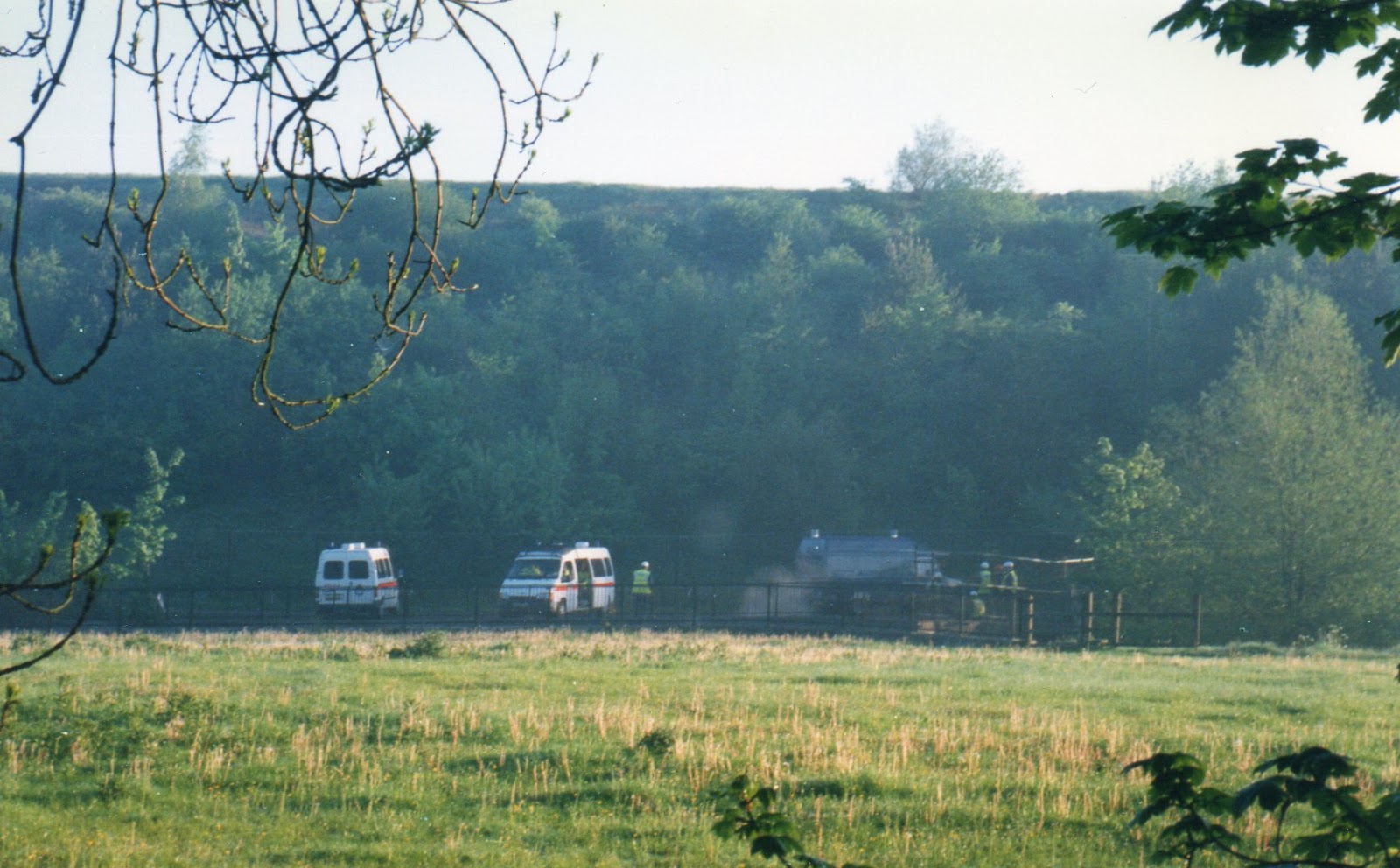
If this was 1997 you would now be headed towards a security fence, lit at night by arc lights, and patrolled by Police, Bailiffs and up to 500 security guards. All this was to remove less than a hundred protesters from the sight of Manchester Airports second runway. The camps were first surrounded by wire and guards, and then the protesters were slowly removed from their treetop houses and tunnels.
 |
| Bored security, 1997 |
I was evicted on the first day, but I returned three days later, at night, along the path you have just walked with Ollie Big Dog and Kim. Our aim was to get back to our camp, appropriately enough called Wild Garlic, which was being evicted. We slipped between the security guards, climbed the fence at a spot where the barbed wire was missing, and evaded the bailiffs who were patrolling on quad bikes with night vision devices. I created a diversion whilst Ollie and Kim made a run for it. They didn't make it.
A few days later I returned with a BBC documentary maker. She too wanted to get inside the security perimeter. She'd asked for a cameraman, and had hoped for some young hotshot with a camcorder. instead she got a grizzled old veteran with a camera the size of a suitcase, who regaled us with stories of wars he's covered around the globe whilst we blundered around in the dark. The film never got made.
5. CAR2
 |
| Zion Tree |
As you walk towards the sound of jet engines you will see the incongruous sight of fully laden jumbo jets rising slowly over the Cheshire Countryside. During the days of the campaign Against Runway 2 the aircraft appeared to grave the top of the great beech of Zion Tree camp.
The camps were located either side of the large tunnel you can now see in front of you, which was build to accommodate the River Bollin.

In 1997 protesters, and journalists looking for a scoop, soon discovered the limitations of security guards paid less than what is now the minimum wage. On dry land they'd hand you over to the police, but faced by a river a few inches deep they decided to keep their feet dry and you could walk into the site unmolested along the river.
When you join the path that runs round the perimeter of the runway, next to a wooden bridge, you will find a sign board that tells you that archaeologists discovered during the building of the runway that our medieval camps were built on the sight of a iron age farmstead. It would be too much to imagine that Lindow Man came from here, but it's not impossible.
.jpg) |
| Manchester Airport Tunnel, 1997 |
To visit the site of the camps themselves, take a little diversion into the tunnel.
On the right, as you enter, would have been River Rats, which you reached form here via a dodgy rope walk over the river. Beyond that would have been the Camp Cliff Richard (funny how we never got the press to run that line, especially once it had been penetrated by the Sheriffs men) where Swampy and the serious protesters lived. Beyond that and nearer the road was Flywood, home of the leery, beery trolls who snaffled the prized donations of food and booze.
.jpg) |
| Manchester Airport Tunnel, 2013 |
Towards the end of the tunnel and also on the right would have been Zion Tree, and on the left my own camp called, appropriately enough, Wild Garlic. No occupied trees survive, but if you carry on out of the tunnel and into the bushes on the far side you come to a steep bank on the left with a muddy ditch in front of it. technically this was probably part of Wild Garlic camp, and the ditch became our moat, complete with drawbridge. On the day it was defeated by a copper with longer than average legs, but it looked the part.
 |
| Wild Garlic camp, 1997 |
Although the poor old yellow hatted security guards were paid peanuts, the expert climbers and rescuers used to get the protesters out of the tree houses and tunnels were collecting a hundred pounds an hour or so for their work. We tried to make their job as hard as possible.
One of the more colourful characters in Wild Garlic was Carl, who came from a rather interesting family in New Brighton. Carl was the proud owner of more piercing than anyone else, and he tried to use these to aid the defences of the camp.
 |
| Carl meets the press with nail |
When the climbers reached his tree house they found him lying with his head against the wooden pallet that made up the floor, attempting to hammer a six inch nail though the hole where his large ear stud had been using the blunt end of a hand axe. It didn't work, the nail wouldn't go into the wood, but when he gave up the climbers told him to lie back down again as they could get an hours extra work out of this. They ordered up some special tools, and then spent the next hour chatting and smoking with Carl.
My own contribution to the defence of the camp was rather more limited. Eviction day found me on day patrol. Down by the bridge across to Zion Tree i met some men in black balaclavas across the water. "Hello," I said, assuming they were with us. "F*** Off," came the reply, as they weren't. They were either a special police unit, or more likely the SAS anti-terrorist unit, called in after bogus claims we'd booby trapped the woods. They demolished the bridge, leaving the River Bollin between me and them, which I thought was a good idea. We'd though Wild Garlic would be hit first and I'd volunteered to help local activist Jeff Gazzard with the PR, so my camping days ended rather mildly as I walked off the site voluntarily.
6. The Airport
 |
| Manchester Airport |
Return to the bridge and turn left out of the tunnel, heading north. As you climb up towards the fire station you will see the whole of Manchester Airport to your left. A marvellous technological achievement, modern air travel has joined the world together like no other achievement. At any one time there is the equivalent of the population of Manchester in the air. On 99 days out of 100 every single one of those passengers will arrive safely, which isn't something you can say about many means of transport.
However it is an achievement only made possible by the chance existence of oil. The kerosene used as aviation fuel has twice the energy density of TNT, and every day Manchester Airport uses 3000 tons of the stuff. As it combines with oxygen when it is burnt, a ton of aviation fuel produces three and a half times its own weight in carbon dioxide, a greenhouse gas and the primary component on man-made Climate Change. In addition the vapour trails of high flying jets also heats the air. A quick back-of-an-envelope calculation suggests that the airports contribution to Global Warming is of the same order of magnitude as the rest of the city of Manchester.
7. Styal Country Park
 |
| Yet more wild garlic... |
Continue along the Runway 2 Trail. After the Fire Station the path is badly marked and continues across the grass, not down the access road. Eventually you descend down some steps to the A538, by a roundabout and near the Holiday Inn. in 1997 this was the Moat House. It didn't usually serve protesters, but if you hung around long enough you'd usually find a journalist willing to buy you a drink for a story.
Cross the main road and continue down the unused road off the roundabout to the north. It can be used as an unofficial car park, as it was in 1997, if you want to start the walk here. Had you been here on the morning of May you'd have found a bedraggled group of survivors from Zion Tree, including a journalist with a bleeding ear, and a battery of press trucks which included everything from ITN to
L!VE TV - although neither the News Bunny nor any Topless Darts players were seen.
 |
| Styal Cross |
At the end of the short road a sign shows you are entering National Trust land. Go through the gate and follow the path, keeping right when it branches after about 100m. You are now following the River Bollin as it meanders through a low gorge.
On the left in Arthur's Wood, the
scene of another protest in 1999 when more trees were cut down during the construction of the second runway.
Cross the river at Giant's Castle Bridge then again at Oxbow bridge. The paths multiply as you enter Styal Country Park and if your not careful you can find yourself going round in circles. I kept left after Oxbow Bridge, crossed a dry valley on Chapel Bridge, and then at a small metal bridge turn left.
This takes you along the holly hedge that borders Norcliffe Chapel and then on to Styal Cross, a Victorian erection on a medieval base that has had a number of adventurers before returning to its original site a few years ago. Go through the gate marker
Quarry Bank Mill.
8. Quarry Bank Mill
 |
| Quarry Bank Mill |
So how did we get from venerating nature as the home of the gods (and sacrificing the odd posh person to her) to seeing it as both the source of a free lunch and a dustbin that never needs emptying?
Part of the answer is here at the mill, for we are now at the birth of the Industrial Revolution.
Built by Samuel Greg 1784, just 13 years after Richard Arkwright showed the way at Cromford, and before the steam engine was a viable concept, this water powered mill showed the future.
The scale of the mill was, for its day, astounding. But the mill didn't just represent technological step change, but a social one as well. For the first time, the working day was set by something other than the natural cycle of the earth, as people served the machines and not the other way round.
 |
| Styal Village |
Whole families worked here, including children from the workhouse who weren't paid. the Greg family also owned slaves in the West Indies, but forced labour for white children continued here for years after it was outlawed for black adults.
So why did people give up their pastoral existence to become wage slaves in a Dark Satanic Mill. You've actually just walked past the answer; the picturesque Styal Village. The mill offered regular work, regular wages and a place to live, something worth the loss of the occasional finger.
Things got better of course, and it was the much maligned Victorians who sorted the factories out. But Dark Satanic Mills still exist, just not in this country, and the products of their sweated labour arrive in this country in part via Manchester Airport.
9. Wilmslow
Explore the mill if you want to, then take the path in front of the Mill Pantry marked "Picnic Area". Continue on a path that again takes you along the River Bollin. There's a diversion to the weir and further on it diverges again, but whichever route you take you eventual end up at the B5166. Turn right and cross the river on the foot bridge next to the road bridge and continue to the car park you see in front of you.
Cross the river again at the bridge and continue straight, ignoring a path to the left. Continue on past the rugby ground on Kings Road. You are now in Wilmslow, home to stars of the Premier League and Coronation Street, and a thriving Aston Martin dealership. At the end of Kings Road is the A538, along which I used to trudge in 1997 on the way to the off license. Well, there wasn't much else to do in the evening at the camps.
At the end of Kings Road turn left to the Premier Inn, on the other side of which is Lindow Moss where we started.
The route:
Leave Lindow Common by the southwest exit, cross Racecourse Road and walk down Lindow Lane, marked as a dead end. Carry on until you reach a T junction at Racecourse farm and turn left. Carry straight on at a crossroads of footpaths and byways until you come to another T junction where you join Rotherwood Road.
Turn right on Rotherwood Road and keep walking until you see a sign for a Private Nature Reserve. Carry straight on, following the purple signs for Lauren's Ride and Bridal Path to Morley. the road becomes a path and then a road again, bearing right until it arrives in the middle of Morley Green.
Cross the road, leaving the village sign on the green to the right and the Cheshire Smokehouse on the left. Continue down the road for about 500m, ignoring the footpath on the right, but taking the one on the left a few yards further on marked Castle Mill.
This leads to a path that soon becomes rather muddy that take you towards Manchester Airport. You will see a red and white radar dish in front of you. Carry straight on, following the path which keeps left when you get to a triangular field.
The path descends towards a wooden bridge. Not far past this bridge, you come to another junction. Take the footpath to the right marked Bollin Valley Way. By the tunnel under runway, join the Runway 2 Trail and turn right over the bridge.
Continue along the Runway 2 Trail. After the Fire Station the path is badly marked and continues across the grass, not down the access road. Eventually you descend down some steps to the A538, by a roundabout and near the Holiday Inn.
Cross the main road and continue down the unused road off the roundabout to the north. At the end of the short road go through the gate marked National Trust and follow the path, keeping right when it branches after about 100m, following the river. Cross the river at Giant's Castle Bridge then again at Oxbow bridge and keep left. Cross a dry valley on Chapel Bridge, and then at a small metal bridge turn left.
Follow the holly hedge that borders Norcliffe Chapel and then on to Styal Cross. Go through the gate marker Quarry Bank Mill.
Take the path in front of the Mill Pantry marked "Picnic Area". Continue on a path that again takes you along the River Bollin. There's a diversion to the weir and further on it diverges again, but whichever route you take you eventual end up at the B5166. Turn right and cross the river on the foot bridge next to the road bridge and continue to the car park you see in front of you.
Cross the river again at the bridge
and continue straight, ignoring a path to the left. Continue on past
the rugby ground on Kings Road.
At the end of Kings Road turn left to the Premier Inn, on the other side of which is Lindow Moss where we started.


 However Manchester Airport's PR department has been putting out the story that 50,000 jobs will be created by the project, and as I arrive at Piccadilly Station and make my way to the bus station I see why a line like that will sell here. Despite my own ragged appearance, I am approached by beggars as I walk, and some of the city's homeless can be seen sitting in the sun in Piccadilly Gardens, surrounded by the concrete buildings, noise and pollution of the city. By comparison with the life of this urban underclass, the prospect of living in a makeshift camp in the middle of the wilderness is highly desirable. Poverty isn't just a lack of money or housing, it is being cut off from the natural world that should be our common heritage.

 I am greeted cordially and I explain I'm here to stay and ask where people are needed. I an told that a camp called Wild Garlic has just been set up and needs people. I ask for directions and are given some meaningless stuff about avoiding Cliff Richard, going through Zion Tree and past Bollin Bay, and I'm pointed vaguely in the direction of the current runway.


.jpg)


.jpg)


.jpg)

.jpg)

.jpg)