Green politics, philosophy, history, paganism and a lot of self righteous grandstanding.

Monday, 10 March 2014

Wild Garlic


Beauty comes in at the eye, but memories enter via the nose. Like the smell of school semolina and new born babies, the scent of wild garlic is one which has stuck in my brain and is forever associated with one time and one place.

The place is here, the damp valley of the River Bollin as it winds its way through the Cheshire countryside, just after its confluence with the River Dean and close to the village of Mobberley. The time is 1997, when Oasis ruled the charts, New Labour is on the brink of power and Swampy is famous.

There should be the smell of wood smoke too, but as I walk the muddy path for the first time in ten years my imagination adds that. It adds other things too, things that have no place in such an idyllic English country scene, arc lights, security guards, police in riot gear or on quad bikes.  

It is May now. The ground is wet, the trees have a thin covering of leaves. Here and there the hawthorn is in blossom. The path rises to drier ground and the scent of garlic, fresh in the damp air, diminishes. As it does so a high pitched whine also rises and then turns into a deep roar. The angry sound subsides to a sigh and a gleaming white jet airliner rises above the trees in front of me.

This is why I was here ten years ago, to stop this bit of Cheshire countryside disappearing under concrete in order to become Manchester Airport’s second runway. We failed, but not though want of trying.

This place changed me, all those years ago. The person who left this spot was not the one who arrived.

Partly this was my age. Twenty seven, what astrologers call the Saturn Return, when the great ringed planet completes its orbit around the sun and returns to the position in the sky it held when you were a baby, a time which has traditionally marked the end of youth.

Partly this was the inevitable result of the way my life was moving. Ten years after leaving my parents home I was, like Odysseus, on the eve of finding my true home and, in due course, my Penelope.

But in no small part I credit the magic of this place, and of the spell that was woven here by the noble wizards and warriors who tried to save this little piece of England from the concrete.

I wasn’t aware of the changes that were taking place in me at the time. A friend I wrote to regularly though was. She noted the change in my letters. At first they were full of the politics of the protest, with talk of Climate Change, emissions targets and government policy. By the end though I wrote about nothing outside of the immediate area of our camp. I described the trees, the mud, the sights and the sounds, the mysterious visitors in the night, and the smell of the wild garlic. My fight had moved from the political to the personal.

--------------------------------------------------------------------------------------------------------

Politically this was the tail end of the Road Protest Movement of the 1990s.

That had started in 1993, on legend-haunted Twyford Down in Hampshire, with a motley collection of Travellers and young activists camping out to stop the widening of the M3 motorway round Winchester. The travelling army then moved to London in an attempt to stop the building of the M11, then up north to stop the M65 near Blackburn.

It all came to a head in 1996, when the building of the Newbury Bypass saw ten thousand trees chopped down and over one thousand arrests. By then the cost had become too much for the treasury and the government pulled the plug on the 'greatest road building program since the Romans'. There was a final cameo at Fairmile in Devon, where Swampy became a tabloid sensation after holding out in his tunnel for a week, but then there were no more roads to oppose.

So when Manchester Airport planned to build a second runway on 400 acres of Cheshire Greenbelt, the travelling circus moved up north and set up camp. This was almost my back yard and so, not having much else to do at the time, I came and joined in.

I pitched my tent in the camp known as Wild Garlic. Located at the heart of the development site, where the new runway would cross the River Bollin, we were as far as possible from civilization and completely out of sight. The camp itself was a cluster of ash, beech and birch trees on a slope, with farmland at the top and flood meadow at the bottom. 

We were definitely rather more chilled out than the big camps. Whilst the others put up fortifications to keep people out, we decorated our ‘front door’ with ribbons to invite people in. Our token defensive gesture was a wooden drawbridge over the muddy ditch that marked the limit of the camp. Come the day the authorities decided to pay us a visit, this was defeated by a policeman with longer than average legs. 

------------------------------------------------------------------------------------------------------------

Ten years ago there were a lot of police in the quiet woods. 

Walking the footpath I am now on by day you would have passed them parked up in their vans, usually bored. Beyond them the Land Rovers of security guards patrolled around a fence topped with barbed wire. More security guards huddled in groups, their rank indicated by the colour of their helmets.

Within the fence were the five camps where the protesters lived. Everyone was waiting for the day when the courts would allow the authorities to begin removing them. Around the camps vehicles had churned the grass into mud so that passengers taking off from the airport looked down on five islands of green amongst a sea of devastation.

By night the area was even busier. Whilst the security clustered under arc lights, figures would move silently in the shadows. When morning revealed a section of fence missing or a lighting rig toppled, the blame was laid at the door of the ‘pixies’.

These three groups of people - police, security and protesters - interacted with each other and this place in complicated ways. 

The security guards, the unemployed of Manchester offered a few weeks’ work at basic pay, were suspicious of the police they were supposed to be working with. They would tell me that once they were home and had taken off their uniforms they were regarded once more as the enemy by the boys in blue. Such was life in nineties Britain. 

Of the protesters, they were mainly incredulous. Most had grown up in the city on council estates. When I first arrived, a group watched in wonder as I put up my tent and seriously questioned if I intended to sleep in it. Of the people who made their homes in rickety ‘twigloos’ in the branches of trees, they had only admiration.

The police were more reticent in their dealings with us. Always with one eye on more serious matters, they usually dealt with us fairly whilst keeping their distance. An extremely laid back liaison officer was assigned, a veteran of two decades carrying a machine gun around the airport, and friction was mostly avoided. 

For example, when the police started taking an interest in the pits we were digging around the camp and covering with tarpaulins, a confidential intelligence briefing was produced with diagrams of IRA mortar positions recently used to attack Heathrow Airport. Noting the similarity we agree to allow an inspection of our holes. Having thus been reassured that our toilet facilities were not a danger to anyone except the person using them, the authorities were placated.

The protesters, meanwhile, were a very mixed bunch. Many were veterans of the previous campaigns, but for many others though this was their first experience of both protest and life outside of the city. Some, products of the antibiotic age and rebels against the advice of parental authority figures, neglected basic hygiene and soon retired from camp on health grounds. 

Those who survived though soon settled into a routine of work and fun. Most took to the air, constructing homes in the sky and aerial walkways to link them.

Those of us with no head for heights though would burrow into the red earth. The clay soil was perfect for this and so we dug in like soldiers preparing to endure a heavy bombardment. The Manchester clay is apparently similar to the soil of the Somme, to the extent that in the First World War the 'clay kickers' who had dug the Manchester sewers were drafted in to tunnel under the German lines. If they were like other soldiers in the trenches, they would have used garlic as a natural antibiotic.

And whilst we tunnelled the aeroplanes continued to fly. The camps were at the end of the original runway, and planes taking off appeared to graze the top of nearby Zion Tree, deafening whoever happened to be occupying the Pterodactyls' Nest twigloo. On the surface the first hint of a take-off was the high pitched whine which slowly turned into a bass roar. Underground the order was reversed, starting with the tunnel walls shaking and ending with the hiss of the plane passing overhead.

Opponents of airport expansion we may have been, but seeing the operations of a large airport at such close quarters it was hard not to be amazed by the marvelous technological achievement of modern air travel, which has joined the world together like no other invention. At any one time there is the equivalent of the population of Manchester in the air. On 99 days out of 100, every single one of those passengers will arrive safely, which isn't something you can say about many means of transport
.
However it is an achievement only made possible by the chance existence of oil. The kerosene used as aviation fuel has twice the energy density of TNT, and every day Manchester Airport used 3000 tons of the stuff. As it combines with oxygen when it is burnt, a ton of aviation fuel produces three and a half times its own weight in carbon dioxide, a greenhouse gas and the primary component of man-made Climate Change. In addition the vapour trails of high flying jets also heat the air. A quick back-of-an-envelope calculation suggests that the contribution to Global Warming from the aeroplanes using the airport is about half of the total emissions from the Greater Manchester area.

Those planes keep me company as I continue along the path. The River Bollin meanders through the trees on our right, a lazy river today with large areas of mud exposed on its flanks, dotted with the debris of previous floods.

But its merry wandering is brought up short when it meets the new runway. Here, at the point that marked the edge of River Rats camp, it has been funnelled into a new course which runs straight as a die under the tarmac. Where my cosy little tunnel was dug there is now a vast, semi-circular cavern ten metres high.

On this side there is no trace of Wild Garlic camp. What I do find though is a newly erected sign board, part of a walking trail marked out around the perimeter of the airport, which tells me that near this spot was found the remains of a Bronze Age village. This is remarkable news. Our primitive camp had been built on top of a settlement from the days of the pagan Britons. I had no idea.
We'd known they were here before us, of course. How could we not? A short walk from the camp, beyond the range of the patrolling security guards, was Lindow Moss, a little community on reclaimed land on the edge of the commuter town of Wilmslow. Lindow Man, known locally as Pete Marsh, had been found there.

Pete, a man who had done no manual work in at least the last year of his short life, had suffered a head injury and apparent strangulation before being dropped into the murky waters of the Moss. This suggests a ritual 'triple death' in Earth, Air and Water, a theory supported by the traces of mistletoe in his stomach, a plant sacred to the Druids of these isles.

Analysis of the radioactive carbon in his bones suggests a date for his death around the first century CE, so this sacrifice could have been made at the time of the Roman invasion of Britain. Could Pete have come from this village, the one found under out camp, and given his life in an attempt to stop the invasion of the globalizing empire that invented concrete?  

So was this perhaps another reason this spot had such a profound effect, these ancient echoes contained in the soil? 

At first digging my tunnel had been a chore. I would force myself to work an hour at time underground, holding back the fear of becoming trapped, or of the roof caving in, before coming up for tea and fresh air. Then one day, as the siege lines around the camps drew closer, my view of the world changed suddenly. Safety, I now felt, was underground behind my locked steel door. My fear was of being caught in the open before I could reach the entrance to the tunnel. 

From then on I slept under the earth, dreaming that I was in a homely cavern deep underground. Perhaps I was influenced by Alan Garner, whose novel The Weird Stone of Briningamen opens with the story of a farmer from nearby Mobberley who sells a white mare to a bunch of knights sleeping under Alderley Edge.

Either way, it was because of this that I missed the pixie. Not one of the ones out to do the fences, but
a real one. Maybe.

Eviction day was approaching and things were tense in the camps. In Wild Garlic Ollie left a candle burning in his tree house when he popped out and set fire to the thing. In River Rats there was a climbing accident and Jonathon, a local man, was attacked by persons unknown whilst wandering in the trees at night.

And then Kim saw her Pixie.

Kim was from the Liverpool Earth First! group, a bunch of radical anarcho-greens from the big city, and so was not the sort person to be usually found out in the woods contemplating her navel and talking to the spirits in the trees. So it was therefore a bit of a shock to her when she leaned out of her tree house one night and saw on the ground below her a real live pixie. The fellow was about two feet high and looked a bit like Dobby the House Elf. She looked at the pixie, the pixie looked at her, and then it ran off through the undergrowth.


Two other people though confirmed that something had been in the camp that night. One person saw the creature running off, but it was too quick for him to identify it, whilst another heard but it but didn’t see it. 
 
I never actually found the tracks, but I suspect it was a fox, as we knew they visited our camps. Or maybe pixies pretend to be foxes sometimes to confuse the cynics, or that maybe pixies are just foxes that you catch a glimpse of in the night at special times. Anyone who’s heard a vixen’s mating cry in a lonely forest at night knows there is no ‘just’ about being a fox; they are spirits of the forest in their own right.

Kim’s story wasn’t unique. Many other people found living in the camps brought on mystical experiences. Living in twigloos brought on powerful dreams and some felt able to communicate with the trees they were guarding. Others saw black cats leaping from tree to tree or heard drumming coming from empty camps. In the woods of Newbury an amphibious beast launched itself out the canal whilst security guards claimed to have seen the ghosts of Civil War soldiers whose graves had been disturbed.

It was in those Newbury woods that Jim Hindle was led by dreams to defend the solitary Middle Oak, whilst at the same time he was haunted by a seeming premonition of its destruction. Druids blessed his tree, but still the dreams continued. Then, one morning, he woke to the sound of chainsaws. Another oak, almost Middle Oaks's twin, sited next to the main road and connected to it by a single strand of rope, like an umbilical cord, had been felled. Middle Oak survived and still stands today.

So if I was changed by my time at Wild Garlic, it was an experience I shared with many others.

-----------------------------------------------------------------------------------------------------

"Sorry"
"F*ck off"

This was the sum total of my conversation with one of Britain's elite soldiers, who I had just caught sneaking over the bridge from Zion Tree to Wild Garlic. Eviction day had found me on guard duty rather than in my tunnel. 

Following on the from the scary men-in-black were much politer police in their riot vans, then swarms of yellow coated security guards in Land Rovers, cheerful Welsh bailiffs on quad bikes then specialist climbers and underground rescue people. Watching them was the assembled mass press corps with their satellite link up vehicles. 

I joined them on the grass next to the Wilmslow Road and found everyone was being served tea by the mobile soup kitchen of the Salvation Army. We were being evicted, but in a very curious way.

--------------------------------------------------------------------------------------
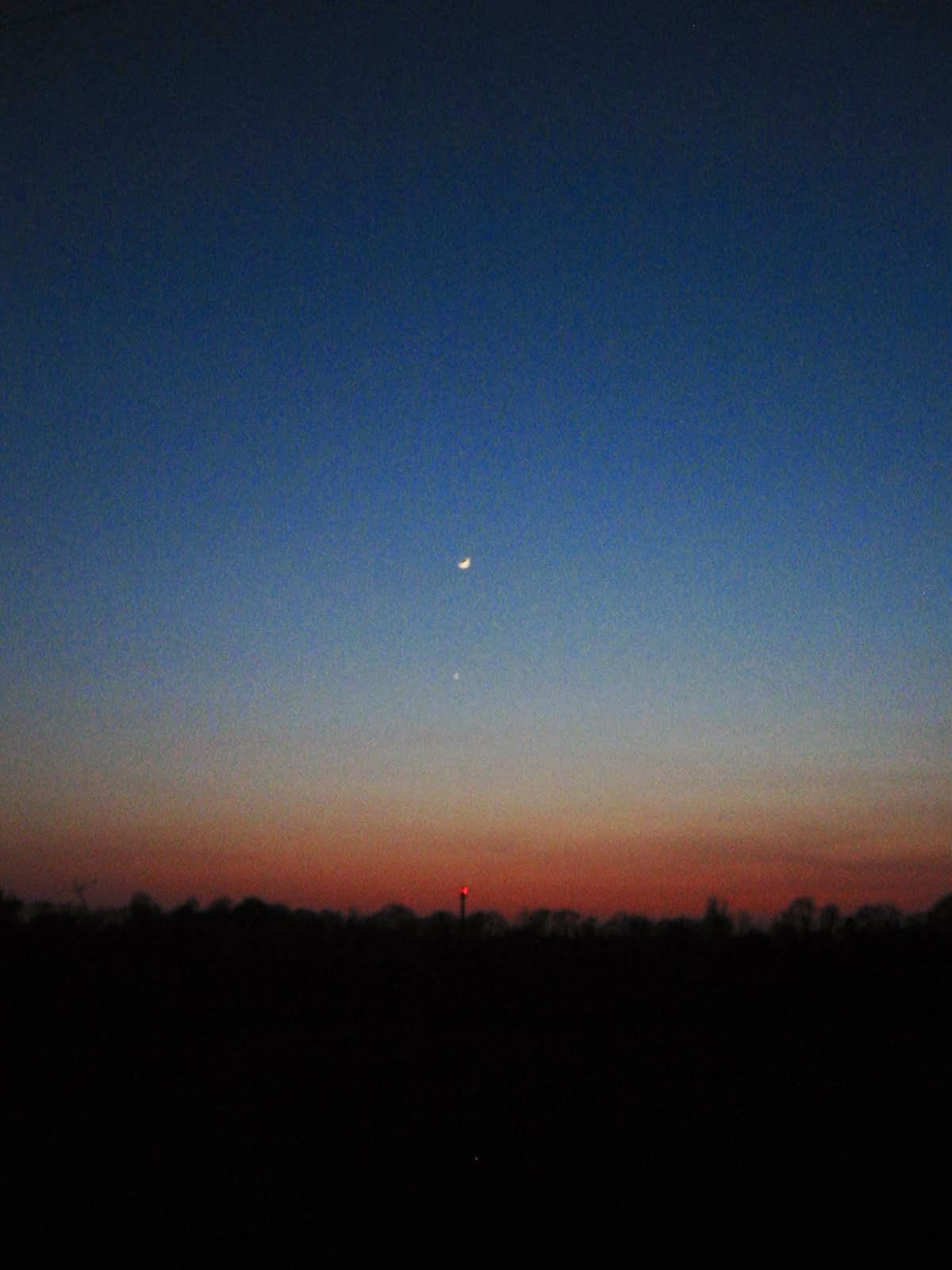
It is now 17 April 2010 and I have returned to the Bollin Valley again, but I find a very different scene to my last visit. 

Venus as the Evening Star sinks slowly into the West, following a blood red sun. The new moon hangs in the sky over the red eyes of the airport's radar dish. Wild garlic still infuses the night air. But the skies are empty, the wood is silent. There are no planes.

An Icelandic Volcano has grounded planes across Europe, and Manchester Airport is shut.

Thirteen years before, we produced a tape of songs recorded in the camps. It is a unique musical record, for a variety of reasons, one of which is that most of the songs are interrupted by a plane taking off. One contribution was called "Silence". Then it was ironic, now it seems prophetic.

In due course the ash clouds will pass and the planes return. Newly washed chives flown in from Ethiopia will reappear on the supermarket shelves, and
travellers will return from far flung destinations.

But for tonight at least, I am alone with the spirits of this place and able to dream that another world is possible.

Friday, 28 February 2014

Policing at Barton Moss, a Personal View

The Northern Gas Gala got underway on 27th November 2013 with forty or so people picketing a small private road called Barton Moss Lane in Salford.

The Lane is very much the edge of town. Next to Manchester City Airport, on one side is the Manchester, Salford and Stockport urban conglomeration. On the other it is countryside as far as Warrington. Historically it has the first canal in Britain, the Bridgewater, and also the last, the Manchester Ship Canal, and the railway that runs nearby was once used by Stephenson’s rocket. Now it was the front line of the new technology of hydraulic fracturing, or fracking.

Fracking is a form of unconventional oil that is currently the target of resistance from campaigners around the world. Their concerns are the air pollution, noise, gas flaring and large number of lorries associated with a fracking site, large amounts of water that needs to be brought in and large amounts of waste needing to be taken out. They fear underground bore holes can crack and methane can end up where it’s not wanted: in the atmosphere, in the ground water and in people.

This combination of local and global concerns makes the anti-fracking movement a diverse one and that was reflected by the crowd gathered on that first morning. The famous Manchester rain was absent, but the Greater Manchester Police and was present in force. A quarter of the mile down the lane the onshore oil and gas company Igas had built a secure compound in which they were preparing for a drilling operation to determine whether or not the area was suitable for fracking.


The police and the campaigners, who styled themselves the Protectors of Barton Moss, squared off. The police commander asked politely if the way could be cleared for lorries to get to the site, and he was politely told that opposition to the work would be non-violent, but also non-negotiable.

Then the pushing started. Slowly the police moved the blockade of young and old, men and women down Barton Moss Lane. Some people pushed harder than others, and soon the first arrests were being made. It would be difficult to call the atmosphere friendly, but certainly there was none of the malice and aggression that was later to characterise the policing. However, if you were arrested by police you knew about it.

Rob Edwards from Glossop had become the first arrest of the campaign the previous day. A well built, former rugby player, he was also an experienced Greenpeace campaigner fully trained in non-violence who knew how to push ‘passive resistance’ to the limit. Adamant he did not want to be put in handcuffs, a dozen TAU officers pushed him face down on the floor and, using pressure points behind his ear, inflicted sufficient pain to get him to release his hands and let them cuff him. His bloodied face as he was loaded into the van became one of the first images of the campaign in the papers.

Two hours after the operation started the convoy of vehicles was safely in the Igas compound. That
first day set the tone for the first month of the campaign: the ‘slow walk’, the pushing and the arrests – a suspiciously regular five a day. The cue for the latter was usually the ritual change over from regular police to blue trousered TAU officers about half way down the lane.

Usually the pace of the walk was set by 82 year old Anne Power, a local Green Party candidate and formidable campaigner. She did not move fast enough for GMP and was regularly removed from the blockade ‘for her own safety’. As a result has Anne has probably now been arrested more often than any other octogenarian in Manchester.

Anne’s arrests did not endear GMP to the Protectors. Neither did an incident on Friday 13th December when police plunged into the crowd to make a seemingly random arrest, propelling a disabled Protector into a ditch in the process and breaking his leg.

However despite these incidents the daily ‘slow walks’, which continued through the worst weather of the winter, developed into a pattern and no matter how many, or how few, arrests were made, the convoys took about the same length of time to get down the Lane.

FLAREGATE


Then at the start of January everything changed. 

The first the Protectors knew about it was when someone spotted a report on the Greater Manchester Police Facebook page of a flare being fired at a GMP helicopter landing at Manchester City airport. Nobody in camp saw anything and it was assumed this might have been a New Year’s Eve firework someone had let off a few days late from one of the nearby estates.

However the police immediately put out a statement saying the flare had been fired from the camp with the intent of bringing down the helicopter, with an ominous reference to the fatal crash in Glasgow the previous November. Two days later the camp was searched, but no evidence was found. Inquiries in the Brookhouse and Irlem estates, and an appeal to drivers on the busy A57 that passed the airport, failed to produce any other witnesses to the flare, but GMP continued to report that it had been deliberately fired at the helicopter by the campaigners.

The Protectors had good reason to be unhappy with GMP after this. Not only were they now being labelled as terrorists, but the search of the tents had resulted in all their bedding being soaked in the Manchester rain – not recommended if you are camping in sub-zero temperatures. However animosity towards the police was usually restricted to the pages of social media, and on the ‘slow walks’ the incident was generally regarded as a bad joke.

BACKLASH


However the police were definitely not laughing now. Arrests became more regular and more violent. 

The campaign was now getting exactly the wrong sort of publicity, but that did not stop the next Solidarity Sunday mass rally drawing eight hundred people from around the country to the site. There were no lorries that day, and almost no police, and everything was peaceful.

However the police continued to repeat the claim about the flare. They even presented new ‘evidence’, in the form of a comment on an un-moderated social media page, supposedly by someone from the campaign, apparently confirming the story. There was no way of proving who posted this comment, and the wording used strongly suggested it was not by the person whose name the poster used, but GMP cited this as further evidence of violence by what they called ‘a minority out to provoke the police’. Such statements were usually accompanied by estimates of the cost of the police daily being present on the Lane in numbers considerably greater than the Protectors.

On the same day as the alleged flare, another curious incident took place. Barton Moss Lane, which is
clearly signed as a private road, is also a Public Footpath, but that Saturday a couple of officers were photographed removing the Public Footpath sign from the top of the lane. The Rights of Way officer at Stockport Council was contacted and said he knew nothing about this and that, as far as he was aware, the lane was still a footpath.

With most of the arrests made being for Obstruction of the Public Highway, this was a very important point. These charges would only stand if Barton Moss Lane was indeed a Public Highway. You can't claim legal aid for a defense against this charge, but fortunately local lawyer Simon Pook was will to defend impoverished protectors pro bono. The courts, which had been taking an increasingly dim view of GMP tactics, and which were regularly releasing campaigners on unconditional bail even if they had been arrested for breach of bail conditions, would be able to decide.

LEGALLY DUBIOUS


As January 2014 came to an end there was still no ruling, but Greater Manchester Police may have started to sense which way the legal wind was blowing. Although there were still plenty of complaints of police violence, arrested campaigners were sometimes just led away rather than wrestled to the floor and handcuffed and on 30th January the police stayed in their vans and let the Protectors walk the lorries down unescorted. As usual the convoy took two hours to get to the Igas site.

Then on Wednesday 12th February,  Judge Khalid Qureshi, in Manchester Magistrates Court, ruled that the Lane was a Private Road and Public Footpath and not a Public Highway. By this time the number of people arrested was well over a hundred and the prospect was that most would now have their charges dropped. It looked like Greater Manchester Police had just arrested a hundred innocent people, and spent nearly a million pounds, policing a peaceful protest that could have been handled by a village bobby on his bike.

For two days after the ruling nothing happened. No convoy passed down the lane and no-one was arrested. Then the police returned with a violence seemingly fortified, and not mollified, by the collapse of their legal case. They started arresting the Protectors once more, hospitalising Vanda Gillett in the process.

Vanda had been pushed in the back by an officer, one of the many minor acts of provocation that now
occurred on a daily basis. Others included punches in the ribs when no-one was looking, threats to “see you later” and boasts about how much overtime pay the officers were receiving. Vanda instinctively replied with a coarse word and was immediate handcuffed and dragged away, her hands almost being pulled backwards over her head in the process. She was left on the ground twitching and apparently fitting.

An ambulance was called, but was not allowed down the lane for nearly half an hour. Supporters of the camp coming to the site after seeing the incident on Facebook  found uniformed officers stopping them at the top of Barton Moss Lane and claiming the area was a ‘crime scene’. Vanda, a mother of five, eventually made it to hospital where she discovered she was no longer under arrest and that, although she had not had a fit, the violence of her arrest had trapped a nerve.

TRESPASS ON A PUBLIC FOOTPATH


The increase in the level of aggression by the TAU was not the only surprise for the campaign. The police were now making arrests for the crime of Aggravated Trespass. This offence, from the notorious 1994 Criminal Justice and Public Order Bill, has been widely used against environmental protesters in the past. However the bill clearly defined trespass as only being possible on land to which the public did not have access. As Judge Quereshi had clearly ruled Barton Moss Lane was a Public Footpath, this charge required the police to claim that the Igas lorries, or themselves, somehow had priority over pedestrians on the footpath, a feat of legal legerdemain that has no precedent.

So that is the current state of play at Barton Moss: the law seemingly on the side of the Protectors, the Law clearly siding with Igas, and the convoys still taking two hours to get down the Lane.

The number of people camping on Barton Moss is small, but they are only there because of the support from the local community. Greater Manchester Police meanwhile continue to act as if the campers are their personal enemies. Conspicuously absent during rallies and media visits, they often arrive just minutes later to carry out more seemingly random arrests. From the use of Aggravated Trespass on a Public Footpath, to the man arrested for drink driving whilst sober and on foot, they act seemingly independent of the law.

The very serious concern for the local campaigners is that violent protests will attract violent protesters. So far this has not happened, and the Protectors are still committed to peaceful civil disobedience. However this is despite, and not because of, the actions of Greater Manchester Police.

Friday, 14 February 2014

Top 5 Cinema Couples Who Failed To Get It On

Valentine's Day, so how about a romantic movie?

We've moved on a bit from the days of the Hay's code, when you could only show a couple in bed together if they each had a leg on the floor on opposite sides of the bed.

But whilst there is plenty of bonking on the silver screen today, romantic films are generally a bit different as all the serious action is supposed to happen after the credits have rolled.

Or does it.

Here are five romantic movies where the end credits might not have been followed by some action between the sheets. 

1. Elaine and Benjamin in The Graduate (1967)


So do they or don't they, that's the question?

Having escaped the clutches of Mrs Robinson and persuaded Katharine Ross not to marry the boring Carl, the film ends with Dustin Hoffman looking a little uncertain about what he has actually done.

I expect most romantic movies would probably end this way if the cameras kept rolling for a few extra minutes. Or it could just be that be that Benjamin is a little disappointed to be riding on a Greyhound bus after spending the rest of the film in a drop dead gorgeous Alfa Romeo convertible.

2. Walter and Hildy in His Girl Friday (1940)


A woman who can hold her own in a conversation is definitely a good thing, but maybe Hildegard "Hildy" Johnson is a bit too much.

Cary Grant and Rosalind Russell play a divorced couple in the news business. You suspect she wore the trousers, which was probably fine as Cary Grant preferred ladies' dresses. Certainly Grant's character seemed to think so and he spends the film trying to woo her back using a variety of means, including getting her new finance arrested over and over again.

The film is just an excuse for the two leads, both at the top of their game, to trade witty banter. In the end however they both end up preferring work to marriage and got their separate ways.

Just as well really as together they stole every scene they were in.

3. Osgood Fielding III and "Daphne" in Some Like It Hot (1959)


In a movie in which nothing is what it seems, from the funeral parlour that is a Speakeasy to the wedding cake containing a machine gunner, the romance between a bass player in drag on the run from the Mob and a multiply divorced multi-millionaire may not be what it seems either.

We know that Marilyn Monroe and Tony Curtis didn't work out as couple, but maybe Osgood and "Daphne" do. He certainly seems happy.

Nobody's perfect, but this film is.

4. Laura and Alec in Brief Encounter (1945) 


A very British film in which the main characters do nothing more erotic than go to the cinema and drink tea.

Supposedly this is because they are both married, but as it was adapted from a Noel Coward play the actual reason may be slightly different.

A metaphor for same sex romance in a less progressive age it may be, but is still one of the most tear jerkingly romantic films ever made which has made an obscure railway station in Lancashire a popular tourist destination.

5. Rick and Ilsa in Casablanca (1942)


Okay, so they probably got it on like rabbits whilst they were in Paris, but in this film he has to let her go off with the leader of the resistance. Well, everyone loves a radical.

We presume this was a supreme act of selflessness although people have subsequently read rather a lot into Boggy saying to Claude Rains' Police Captain "This could be the beginning of a beautiful friendship."

Thursday, 6 February 2014

Film '79

Watching an entire film all the way through is a pleasure that largely disappeared when the children arrived, but every now and again I make the effort. So last week we watched Quadrophenia. A great film, even if it does remind me of how utterly crap being a teenager was.

The soundtrack is possibly even better than the film, and what a tragedy it is for us cinema fans that Phil Daniels preferred the stage never played a major leading role on screen again.

The film came out in 1979, a year to forget in the real world. A right wing swing in this country brought Mrs Thatcher to power and an illiberal revolution in Iran brought the Ayatollah to power. We also had a second oil shock and the Soviet invasion of Afghanistan. All four events caused crises that are still ongoing.

However on the silver screen things were someone better, suggesting a sort of symbiosis between great cinema and global troubles, although that would suggest we should be in the middle of a golden age right now.

1979 was two years after Star Wars rewrote the rules on science fiction films. Whilst we all waited for The Empire Strikes Back, a splurge of films tried, but entirely failed, to clear the low bar set by the A New Hope.

In 1979 we these included Star Trek: The Motion Picture, or the Motionless Picture as it was dubbed which, as an odd numbered Star Trek film, was of course pants. Then we had the lightweight Disney film The Black Hole, then a movie that showed us the future looking like Las Vegas, namely Buck Rogers in the 25th Century, and finally the leading contender for the worst Bond film of all time - Moonraker.

And yes, I saw every one of those in the cinema.

But not every sci-fi film of the year was rubbish, for this was also the year of Alien. Ridley Scott, H R Giger and a great cast, including Sigourney Weaver and John Hurt, got together to give us possibly the best outer space horror story of all time.

J D Ballard actually turned down the novelization after reading the script. He spent the rest of his life kicking himself, but in his defence I doubt anyone reading the minimal dialogue in 1978 could have had any idea how amazing a film would be made from it. In due course the dripping chains and so on would become clichés, and the Alien franchise utterly interminable, but you can't get past how great the first film was.

Another film, written as science fiction, turned into science fact before its run in the cinema had come an end. This was The China Syndrome.

The story of a nuclear accident was dubbed "sheer fiction" by the nuclear industry when it came out, but then twelve days later the TMI-2 reactor at Three Mile Island went into meltdown. Jane Fonda, Michael Douglas, and most of all Jack Lemmon, act their socks off on screen, but arguably the real horror was provided by the news headlines.

To date no fatal cancer has been attributed to Three Mile Island, and compared to Chernobyl and Fukushima it seems a very minor accident, but the terror hasn't gone away and possibly this is where it all started to go wrong for the nuclear industry.

Meanwhile, up in New York, Woody Allen was in a purple patch. Manhattan has the mild mannered, 42 year old, Jewish intellectual dating the then seventeen year old granddaughter of Ernest Hemmingway, something that would have given the old man a heart attack had he not already topped himself. Not withstanding the rumours about Mr Allen and young girls which this helps to stoke, it is a good film, surviving being black and white and scored by Gershwin without coming across as too arty-farty.

Also from the other side of the pond, and somewhat more epic, was Apocalypse Now. The most quotable Vietnam movie of all time, it survived a production process that would have sunk a lesser director than Francis Ford Coppola. Pretty much nobody involved in the film, except Harrison Ford - and he's hardly in it - ever scaled such heights again, but that doesn't matter. This is one of those great film that you suspect even the person who made Marlon Brando's tea still talks about being involved in.

Various versions have appeared since, but the original edit is still probably the best. Coppola said the production mirrored the war itself; too much money, too much equipment and everyone going slowly insane. Once the shoot was over he had the unenviable job of assembling a film from miles of mostly useless stock.

However what emerged from the slag heap was an absolute gem of a movie. Thanks to Apocalypse Now ceiling fans now always turn into helicopters, Ride of the Valkyries is no longer just part of the Ring Cycle and Heart of Darkness is just the book of the film. Even the Vietnam war itself seems to be just a reflection of Coppola's nightmare vision.

However the Yanks weren't the only ones making great films that year. Starring a young Ray Winston was Scum, a cheerful tale of what we used to do with young offenders in less progressive days. Too controversial for the BBC when it was written in 1977, most people didn't actually see it until it was shown on Channel 4 in 1983. Mary Whitehouse, who would rather we had all been watching Jimmy Saville, won a private prosecution of Channel 4, although the decision was overturned on appeal. Like Doctor Who, The Goodies and almost everything else she hated, it is now regarded as a classic.

Ray Winston though wasn't the only hard man on the screen. Bob Hoskins was also acting pretty mean in The Long Good Friday. A delay in the release meant the film came out in 1980, but production was completed in '79.

Possibly the best British crime film since Get Carter, it both looks back to the seventies, the era of The Sweeney and the IRA Mainland Bombing Campaign, but also forward to the eighties and beyond. Hoskins, a crime boss having a bad day at the office, is trying to make his dodgy business legitimate and redevelop the London docklands in the hope of luring the Olympics to the city, but comes up against an organisation even meaner than his.

But the film of the year for me is none of the above, worthy though they are. For 1979 was also the year that Monty Python had their annus mirabilis, and asked what, apart from giving us pretentious phrases to repeat ad nauseum, the Romans had ever done for us.

Still officially banned in Harrogate, The Life Of Brian is really just a series of sketches, at least a dozen or so being amongst the best the Pythons have ever done, but somehow it does all hang together reasonably coherently, thanks to Graham Chapman's wacky charisma, the team's underlying humanism and Eric Idle's musical finale.

Monty Python were six brilliant comedians who changed British TV comedy, but it was by sticking together long enough to come up with The Holy Grail and The Life Of Brian they escaped the confines of the small screen and became immortal.

Yes, it's a bit of a shame that whilst forty years ago people watched the Pythons because they hadn't a clue what they were going to say next, whereas today people go to Spamalot knowing every line in advance, but they were still brilliant.

So that was the world of film as the seventies drew to close.

A lot of science fiction for teenagers, teenagers on mopeds, teenagers in a borstal, a teenager dating a middle aged man, a nightmare in outer space, a nuclear nightmare, the Vietnam war as a nightmare, a gangster having a nightmare day and Monty Python telling us to Always Looks On The Bright Side Of Life. 

In the decade to come we were all going to need that advice.

Thursday, 23 January 2014

Fracking: The Debate Gets Personal

I think I’ve been around this campaigning lark long enough to know how it is supposed to work. Activists come out with the hyperbole and ad hominems to get themselves noticed, and the government responds with dull statistics and boring reports.

However the current debate on fracking seems to have all this back-to-front. The Prime Minister says we are “irrational” with a “religious” opposition to fossil fuels, and Lord Deben thinks we are all ex-Troskyites.

Deben is, of course, the easiest to disprove. Ex-Trotskyites don’t become environmentalists. They renounce their left wing views, become Climate Change deniers and get jobs writing for the Daily Mail.

And Climate Change is what it’s all about. Talk to a bunch of anti-frackers, like the crowd currently camping out at Barton Moss in Greater Manchester, you will find a variety of reasons for opposing shale gas, but Climate Change is the one that never goes away.

Perhaps we really have learnt lessons from the mess in America, although I would really like to hear that from someone with a better record of safe hydrocarbon extraction than former BP CEO Lord Browne. Maybe the rules in this country are good enough to make the industry behave, and the underfunded Environment Agency is up to enforcing them. Possibly the claimed health risks of fracking are a myth, notwithstanding the reluctance to disclose what fracking fluid actually is or to disclose court documents. And conceivably fracking sites aren’t that much of an eye sore, although surely only a Conservative Party Chairman could describe something that covers an area the size of two football pitches and has a fifty foot tower as “no bigger than a house” (Grant Shapps on Question Time).

That still brings us back to Climate Change. Ignore for a moment the tricky issues of fugitive methane emissions, which if they exceed more than 3.2% of the gas fracked make shale gas worse than coal. Forget about the soot from coal which contributes to global dimming and so partly off-sets the carbon dioxide emissions, and don’t worry too much that the gas Putin pipes to us, although politically a bit iffy, arrives here more cheaply and easily. This still leaves us with the question of whether we should we replace our dirty old coal fired power stations with shiny new ones running on fracked gas? 

If the switch was there to be flicked right now this would be one of those thorny issues, like nuclear power or the incineration of domestic waste, that splits the Green community and leads to the likes George Monbiot and Jonathon Porrit having pops at each other.

But the reality is that the switch cannot be thrown yet and may not be ready for a least another decade. Even at Barton Moss, the current front line on fracking, we are looking at two months more exploratory drilling, six months analysing the data and the best part of a year getting ready if Igas do want to come back and drill. A fracking boom would require 20 to 40 Barton Mosses a year, and that just isn’t going to happen soon.

So even if all those irrational and religious ex-Trotskyites were to pack up and go home tomorrow, it would still be 2025 at the earliest before fracking in the UK could really be considered up and running. 

And this is where the dull statistics and boring charts come in. There is no way, say the experts, that we can bring a brand new fossil fuel online in the middle of the next decade and still keep Climate Change to below two degrees by the end of the century. No way. We need renewable energy as soon as possible. The climate cannot wait for us to ride out two decades of fracking boom and bust first.

So the Prime Minister and Lord Deben can fire away with all the rhetoric and invective at their disposal. They can parrot the line on jobs, or safety, or whatever else the industry emails them. Their formerly left wing friends at the Daily Mail can join in too. But we will just sit back and point to the graphs, the climate models and the science papers and reply the computer says no. 

It may not be the way round you’re supposed to do things, but that’s the way it is.