Green politics, philosophy, history, paganism and a lot of self righteous grandstanding.

Saturday, 18 May 2013

Protest Walks #2: Bluebells in Stanworth Valley

This is a five hour walk through Lancashire countryside that takes in a secret Holy Well, a tower celebrating a Victorian right to roam and the scene of Britain's first almost entirely aerial road protest.

The walk starts at the Roddlesworth Cafe and Information Centre Tockholes, Darwen, Lancashire, BB3 0PA. There is a public car park next to the Royal Arms pub and the number 223 bus runs between Blackburn and Tockholes four times a day.

The best map is the Ordnance Survey Explorer Map 287.

There is some climbing and, this being Lancashire, it can be a bit wet underfoot.

Actually, very wet.

1. Hollinshead Hall

Opposite the cafe is the Tockholes plantation, an area of broad leaf woodland that surrounds some reservoirs. Cross the road from the cafe and follow the path that descends into the trees. When it crosses a paved path turn left. About a mile and a half further on you come to the back of a car park that is now permanently shut. Continue on about 200 meters and you find yourself in the remains of the enigmatic Hollinshead Hall. 

This is now in ruins except for one building, the Well House.

Little is known about the origins of this hall, which dates from some time in the Middle Ages but was abandoned in the late nineteenth century and then demolished in the twentieth.

The Well House is kept locked today, but inside you can just about make out the sculptured lion's head out of which the water flows, flanked by two stone troughs. Above and behind the building is another stone trough, which is accessible.

This all suggests something important, but what?

The name of the hall may not come from the Hollinshead family, or it may be derived from the Old English haeligewielle meaning holy well, which then became Holy Head and hence Hollinshead. This is backed up by the 1845 book Mansions of England mentions the Well House and says it used to be called 'Thee Holy Spring'.


So we may have an Anglo-Saxon holy well, but that's not all. The building is inscribed with the coat of arms of the Radcliffe family, which used to own the land. The Radcliffe's were Catholics and if the well house dates to the 1680s, as it appears to, they may very well have been using it as secret baptistery.

On top of that the place is apparently haunted, although the time I spent the night here - admittedly in the back of a transit van and not the Well House - I didn't notice anything out of the ordinary.

Whatever you make of it, enjoy the peace of the woods around the halls, as it's likely to get a bit windy as we go on.

2. Jubilee Tower

Return to the closed car park and cross the road. On the other side, a few meters to your right, a large sign welcomes you to the West Pennine Moors. Follow the stone signs which show the way to Jubilee Tower, also known as Darwen Tower, which soon comes into sight in front of you, standing on Beacon Hill like a Victorian space rocket waiting for blast off.

The best time to do this bit of the walk is mid-August, when the heather is purple. I did it in May, when the wind was a tad more bracing.

The tower gets its name as it was completed for Queen Victoria's Diamond Jubilee, but it also marks a rare victory in the ancient battle for a Right to Roam.

In 1870 the local absentee land owner had closed the moor to people and turned it over to grouse. A local man, William Thomas Ashton, crossed the moor regularly to deliver coal, and whenever the gamekeepers blocked the path, he cleared it.

Eventually the matter ended up in court, where Ashton won.

The tower is open all year round, although you probably won't want to hang around too long at the top. From there you can see Kinder Scout, Blackpool Tower and on a good day the Isle of Man. However even on a bad day you should be able to see Winter Hill to the southeast. A fairly non-nondescript lump with radio transmitters on top, the hill was the scene of a less successful trespass in 1896.

3. Tockholes

Once you've finished pretending to Saruman in the tower leave Beacon Hill by taking the path north, following signs marked Witton Weavers Way. Once you leave the moor you take a left - but you can't see the sign until after you've passed it. The path then joins a concrete Water Board road. When it joins a tarmaced road keep right on the black stuff, eventually passing Earndale Reservoir on the left (pictured) and Sunnyhurst Woods on the right.

Once past the reservoir carry straight on and once you've gone up the hill turn right. You pass Belstone Stables on the right and the path becomes Weasel Lane, eventually emerging in Tockholes itself just opposite the United Reform Church.

If you've had enough your starting point is a mile down the road to the left.

If you're game to press on turn right and then left immediately after the church, going down Silk Hall. If you have a spare pound you could buy a snack or half a dozen eggs from Julie's Cake Box (pictured). At the end of the short road ignore the sign which suggests the path goes left and carry straight on across the field in front of you. Keep to the left of the wall and cross two styles.

When you reach a Chapels Lane turn right, passing the dramatic entrance to St Stephens Church. Unfortunately behind the fine gateway is a rather disappointing modern building.

Turn left after the church following the sign "Public Footpath" and at the end of the lane, where you appear to be in someone's garden, follow the sign "Rambler's Footpath".

This leads you out into a series of fields, linked by styles, and you should be heading towards the sound of traffic, still following the Witton Weavers Way.

Before you get there you you will find yourself in an area of woodland. I found myself in a field of bluebells, late thanks to snow in April (possibly caused by the premature melting of the Arctic ice) but still a very welcome sign that the season of Beltane was upon us.

On the other side of the woods though you cross a field and find a very different view; the westbound carriageway of the M65 motorway.

4. Canals, Railways and Motorways

Follow the path alongside the motorway, taking care to observe the interesting debris on its verges. When I was there these included plastic bags, fast food containers, a ring-binder file and what looked like a pair of trousers - an unusual thing to loose whilst heading towards Preston at 70mph.

In 1995, as part of the "biggest road building program since the Romans" the motorway was extended eastwards, with this bit being opened in 1997 by Jack Straw and a large contingent of police. One of the most deprived parts of the country received a major new transport link, and the 52,000 vehicles a day now fly through an area of
"Special Landscape Value".

When you reach the road, turn right and use the charmingly graffitied underpass to cross to the north side of the motorway. Mercifully, you are soon on a quiet country road again.  You pass an airgun range on the left. Ignore the Witton Weavers Way as it heads off right and stay on the road. You are looking for a footpath off on the left. It's hard to spot as it's signposted from a short road that joins on the left and is next to Stocklough House. If you get to some industrial units you've gone too far.

As you walk though the wood you cross an old stone bridge that is one of the relics of an earlier transport system; the Blackburn to Chorley line of the Lancashire Union Railway. It closed to passengers in 1960, three years before the Beeching axe fell on other branch lines. By the time the M65 extension was built, British Rail itself was being broken up and privatised and the West Coast Mainline was in such a parlous state seasoned travelers were allegedly getting off Scotland to London trains at Preston and getting buses to Manchester, which usually overtook the frequently held up trains.

The path emerges from the trees next to the Leeds-Liverpool canal, another transport system, and one the dates back to the dawn of the Industrial Revolution.

Today, people who oppose new roads look back nostalgically to the heyday of the railways. But when the railway boom was at its height, early environmentalists like William Morris and John Ruskin looked back fondly to the days of the canal. In Morris's Utopian story, The News From Nowhere, goods moved on barges powered by a mysterious clean energy source.

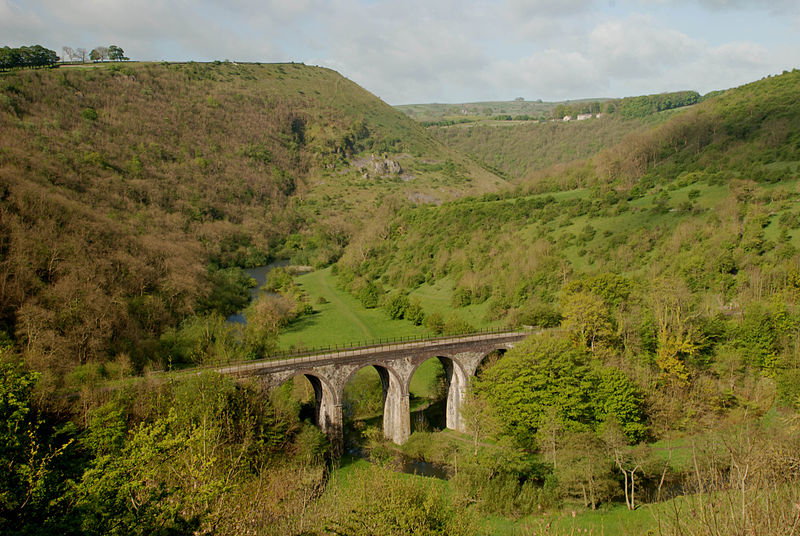
Ruskin meanwhile railed against the Headstone Viaduct at Monsul Head, claiming "The valley is gone, and the Gods with it". Seeing as how this is now subject to a preservation order and one of the most photographed structures in Derbyshire, you wonder what he would have made of what happened to Stanworth Valley.

5. Stanworth Valley

Opposition to the motorway extension started almost as soon as it was announced, but protests stepped up a gear when veterans of the campaign against the M11 in London moved into Cinderpath Woods in May 1994. They were evicted, and after several other preliminary skirmishes the protesters ended up accumulating in Stanworth Valley for a new experiment in direct action - living without the ground.

The valley being low lying, and the Lancashire weather being somewhat inclement, the bottom of the valley rapidly became a 'quog'. So the protesters took to the trees.

Not only would they have to be physically removed from the trees before the road could be built, but after a well-wisher from Cheshire had had a letter delivered to the occupants of a Sweet Chestnut tree standing in the path of a the M11, inhabited trees were recognised as legal dwellings and so formal eviction proceedings had to be held before clearance work could start.

Hidden away from the world in the valley, with less support from the locals than at other protests, the inhabitants of the 40 odd (some very odd) tree houses were mostly in a world of their own. People could loose each other for days along the four miles or more of rope walkway linking the twigloos.

When evictions eventually started the Under-Sheriffs men quickly cleared the ground, but struggled to clear the trees. Until they learnt to cut walkways with knives on poles, this left the security guards living like Morlocks on the ground whilst the elevated protesters moved freely above them.

The Under-Sheriffs men moved in on May morning 1995, after a raucous and skyclad Beltane party by the protestors. Previous tree evictions had used raised platforms called cherry pickers, but for the first time contracted climbers were brought in. This was a move that would eventually see the Sheffield based team who did eviction work ostracised by the rest of the climbing community, but here in Lancashire the main problem they faced was how to deal with people who moved through the trees without harnesses and showered them with pasta and baked beans.

Eventually the inevitable happened and the last protestors was removed and the trees felled.

Two bridge sections each of 270 meters in length and weighing over a thousand tons each were manoeuvred into place a hundred feet above the valley.

AMEC appear to be quite proud of the work, and it's true that the direct destruction only extends 10 meters either side of the road and that wildlife is free to pass under the motorway - not an insignificant fact as one of the worst things about busy roads is the way they divide up eco-systems into tiny islands.

However directly under the span of the bridge no plants grow and litter has rained down from the carriageway above into the beautiful valley.
 
6. Back to Tockholes

The path picks up the Witton Weavers Way again, which turns left and passes under the motorway on the west side of the valley. A couple of hundred meters further on you turn left again at a style and descend into the valley. 

Away from the M65 it is a pleasant place once again. Amongst the bluebells I found the remains of a firepit. What camping in the lee of a six lane motorway would be like I don't know, but that aside this is a magical spot.

The path crosses the stream at a wooden bridge, and when you ascend again you can see Jubilee Tower in front of you again. Another old bridge
means you've again crossed the trackbed of the Lancashire Union Railway. Continue on to Bradley Farm and turn right in the farmyard, leaving by a farm track that heads due south, again following the Witton Weavers Way.

At a confusingly signposted junction turn right and then almost immediately left. Don't go down the slope. You follow the vaguely marked path across fields staying to the left of the fence. Cross the valley at the footbridge by Red Lea
Farm. On the other side it joins a paved road. You can either turn right on the road, which soon doubles back on itself, or take a shortcut by following the footpath in front of you, but it is a bit steep. 

When the path rejoins the road turn left and head towards Abbey Village. Arrive in the village just behind the Hare and Hounds pub and turn left towards the rake Brook Reservoir. Just after the water turn left, still following the Witton Weavers Way. When you get to the Roddlesworth Reservoir turn left again, even though this puts the Jubilee Tower on your right. However the path follows the edge of the reservoir
back round to the east and towards where you started from.

The Witton Weavers Way eventually exits left, but ignore it and carry straight on on the main path. there are two Roddlesworth Reservoirs, and just after the second one the path you are on is crossed by a footpath. this is where we began and if you turn left you find yourself back at the cafe where we began. 

They sell locally produced produced and fairtrade food and organic pies, so if you've made it this far please treat yourself.

Thursday, 25 April 2013

Another World Is Possible: Port Sunlight

Port Sunlight was somewhere I'd heard of, but had never been to, until I passed through in February 1997 whilst campaigning for the Labour Party in the Wirral South Byelection. As I was given my leaflets I was quickly briefed on how the election had been called after the death of Barry Porter, which was a little bit of a shock as that was my Dad's name and I was counting on him for a lift back from the station.

Seeing the leafy gardens and Ford Mondeos I remember thinking that's there's more chance of Tranmere Rover getting promoted to the Premiership than Labour getting an MP returned here.

But Labour did indeed win, overturning an 8000 Conservative majority to return Ben Chapman, the son of a farm worker, to Westminister, a sign that eighteen years of Conservative rule may be about to come to an end. Tranmere Rover were less lucky though, missing out on the promotion play-offs again.

But if Bebington is now about as posh as Merseyside gets, Port Sunlight at least has a more proletarian past. It was built by the ruthless capitalist, paternalistic philanthropist, arch Imperialist and connoisseur of the arts William Lever, one of the two Lever Brothers who made their fortune out of Sunlight soap, who built the place to house his workforce.

Port Sunlight has two claims to fame, that it is an example of an ideal community designed by a wealthy industrialist, and that it is styled in the manner of the Arts and Craft Movement.

Lever wasn't the first Capitalist had built a decent place for the great unwashed to live. Richard Arkwright had used the prospect of good housing to persuade families to move to Cromford to work in the first every mill over a century earlier, and Robert Owen had been carrying out an experiment in Utopian socialism in New Lanark for more than eighty years before work started at Port Sunlight.

However whilst Owen was experimenting with Utopian socialism up in Scotland, Lever was very much the Liberal.

It's easy to look back nostalgically at old Liberals like Lever. After all, they're so much nicer than the Neoliberals we have today. Today, Sunlight soap would be made in a sweat shop in Burma, with the Levers holed up in a tax haven on the other side of the world.

But there were always limits to the liberalism of people like Lever.

Yes, the great unwashed could be decently housed and guided to live more righteous lives, but their wages would increase by less than his wealth, and nobody had the right to stop Lever's brand of laissez faire capitalism spreading round the world.

There was also no local democracy here, or any attempt at communal living like in New Lanark. Instead Lever knew exactly how he wanted to clean up the Working Class who moved into his houses, and so he dictated exactly how they should live their lives.

George Orwell called in on his way to Wigan Pier in 1936. He liked the houses and the low rents, but was unhappy about the rules and regulations Lever set control his tenants, seemingly on the basis that it was slum dweller that made the slum. Orwell, knew that the pub was an imprtant part of Working Class life, and who wrote an essay on the perfect English pub, lamented the one "dismal sham-Tudor" pub provided.

Neither can we really claim that Port Sunlight is the best example of Arts and Crafts style housing in Britain. That's probably Blackwell in the Lake District for the real thing, or Wightwick Manor in Wolverhampton, a place which made Andrew Lloyd Weber cry, for an off-the-peg example.

However it is fairly unique in that it is Arts and Crafts houses for the ordinary man, which is actually a bit disappointing for a movement that aimed to improve the lives of the ordinary man.

The Arts and Crafts movement was inspired by the radical Conservative John Ruskin and the anarchic Socialist William Morris.  Both were
equally horrified by the shoddy goods that the Industrial Revolution was producing and the shoddy lives led by the industrial Working Class.

It's noble aim was to take on Adam Smith's division of labour, replace the wage slave with the skilled craftsman and give everyone beautifully designed and hand crafted objects.

Unfortunately these ideals could rarely be realised in real life. Objects could be beautiful or mass produced, handmade or cheap, but they couldn't be beautiful and cheap without either working with industry or working for industrialists. So at Port Sunlight we have one of the world's most successful Capitalists building houses in the style of a movement that opposed everything about the way he did business.

Since 1980 you haven't needed to work for soap factory to buy a house in Port Sunlight. House prices are about the national average, although a little higher than the Merseyside average, and all told the area appears to be for the moderately well off rather than stock brokers. Certainly the VWs
outnumber the Mercedes.

There are still rules and regulations if you live there, but there's nothing to stop soap dodgers like me turning up for a nosey round.

The village is centred round the war memorial, which stands opposite the Lady Lever art gallery. It may seem strange that the village is built around a memorial to a war that happened forty years after it was built, but apparently they were saving the
spot for a postumous cast of Lever himself.

Beyond the War Memorial is the Lady Lever Art Gallery, where Lord Lever showed off his art collection. I don't know what his employees made of it, but he was very keen to show them. It has really a great collection of work by those other rebels against the industrialised world - the Pre-Raphaelite Brotherhood. Like the Arts and Crafts people, the PRB had a mixed relationship with the Establishment they'd set out to rock.

Like Orwell, I want my idyllic cottages a less neat and my life a bit less controlled than Lord Lever would have liked.

All told Port Sunlight shows what's possible when philanthropy meets good design. There's no reason why our cities shouldn't be beautiful as well as useful, human sized rather than supersized.

Another world is possible.

Sunday, 21 April 2013

My Top Five Westerns

A few weeks ago I turned the TV on a few minutes before the film I wanted to watch started, and caught the final few minutes of How The West Was Won. George Peppard was driving family across gob smackingly gorgeous Monument Valley scenery in an open wagon. Then the scene cut to aerial shots of the 1960s America pioneers, like his character, had helped to forge; a monolithic cornfield, soulless skyscrapers and a massive motorway junction.

Save to say that scene probably didn't have the effect on me that the director had intended.

That said, I do like Westerns, although they are a strange genre.

I can easily understand why universal themes such as love, war, crime and comedy have become established in the movies, but why a brief period of nineteenth century American history should have become a staple of global cinema is a bit of a mystery. After all, the equivalent period in British history was potentially just as exciting, but didn't really catch on.

To historian Arnold Toynbee this was down to the romance of the nomad, and he compared how the cowboy is remembered in the USA to the Mongolians who look back the great days of Ghengis Khan.

But as another late, great historian, Eric Hobsbawm, has pointed out, only the American cowboy has gone global. John Wayne did indeed play Genghis Khan, but the film is now only remembered because many of the cast, including Wayne himself, died of cancer, possibly from nearby nuclear tests.

The success of the Western, probably, is mostly due to the power of Hollywood, backed up by politicians, from Kennedy onwards, who used the myth to their own advantage until, in 1980, a real fake cowboy made his way into the White House, followed in 2000 by a fake, fake cowboy.

And a myth the West has always been fake, even when the West was reality.

In his Frontier Thesis of 1893, Frederick Jackson Turner claimed that in settling the West, Americans finally ceased to be Europeans and finally became themselves. He discounted race, class and gender, and said the West was defined by violence, individualism and a distrust of authority. As history it was pants, but as a myth it was brilliant. Only a decade after the publication of his paper the first Western movie, The Great Train Robbery, had its premier in New York.

Very few of those early Westerns are remembered fondly - which is a polite way of saying they were crap - and the classic films generally belong to a narrow era that started with John Ford's Stagecoach in 1939 and ended with the spectacular turkey Heaven's Gate in 1980.

If I were to make a list of the five best Westerns I'd include the usual suspects of High Noon, The Searchers, The Wild Bunch etc, but this isn't that sort of list. The standard interpretation of the myth of the West doesn't really interest me. I could also have chosen A Man Called Horse, Little Big Man, Dances with Wolves and other films that centred on the American Indian experience, but I'll save that for another time. What I couldn't do though is choose my top five female characters in Westerns. A Western is more likely to have a car chase than a strong female character.

Instead what I have here is a very subjective list of Westerns that mean something to me. Here goes.

5. The Good, the Bad and the Ugly (1966)

As the Western is now part of the world's culture, it is not surprising that it has had influences around the world. Perhaps most surprisingly it took root in is the country the USA so comprehensively defeated in World War Two, Japan.

Akira Kurosawa transferred the Western to feudal Japan, and so well did he understand the rules of the genre that his films ended up being remade as real Westerns. The Seven Samurai for instance became first The Magnificent Seven, and then Battle Beyond the Stars - a Western in outer space. Hidden Fortress skipped the Western genre entirely and went straight on influence Star Wars - another sci-fi Western.

His film Yojimbo, the story of a lone Samurai who walks into a town ruled by two feuding gangs and proceeds to wipe them both out, was itself inspired by Dashiel Hammett's semi-autobiographical 1929 detective novel Red Harvest. It too became a Western, not in Hollywood, but in Italy.

This was Sergio Leone's A Fistful of Dollars, the film that made Clint Eastwood the last actor to become a star by appearing a Western. That film was followed by For A Few Dollars More, which added Lee van Cleef to the cast. Filming in Italy meant a nominal 'Mexican border' location', and so in its travel round the world the Western regained some of the multiculturalism of the Old West which had been purged by Hollywood.

For the third part of the loose trilogy, Eastwood and van Cleef were joined by Eli Wallach, one of the most unlucky actors in Hollywood. He'd been signed up to play the lead in From Here To Eternity, but Frank Sinatre allegedly used his mob connections to get the role, and the Oscar.

Longer than a cattle drive across Texas, and more a series of set pieces than a film with any sort of plot, this is genre film making at its best, with any pretence to be historical fiction completely out of the window. Like other Leone Westerns, the scenery is almost a character in itself, and Leone appears to direct around Ennio Morricone's music rather than the other way round. Indeed, you only need to here a couple of bars of the classic theme, even on a ukulele, to imagine the tumbleweed blowing across the prairie, the cloaked figure slowly chewing tobacco and the extreme closeup to a pair of shifty eyes.

Arguably Leone's last Western, Duck, You Sucker! (also known by the marginally less macho title of A Fistful Of Dynamite) is better even though it does seem to be saying something serious about anarchy and revolution.

There is nothing whatsoever serious about The Good, The Bad and The Ugly.

4. The Man Who Shot Liberty Valance (1962)

But the West wasn't a myth hanging in the air waiting for an auteur like Leone turn up and make an artfully violent film out of it. Instead it exists because it is a foundation myth of a people creating order out of a state of primordial chaos though their own actions.

This is all very much an American thing. Over here in Blighty a cowboy, of course, is not a heroic cattle hand with a chiseled jaw, but a dodgy builder with an exposed butt-crack. The British Empire had its wild frontiers, but they (almost) always had law and order.

Take Canada, for example, which bordered the real West. The Klondike gold rush, the last real eruption of that old frontier spirit, saw prospectors hoping to get rich quick land in Skagway, Alaska. There, whilst hooping it up in the saloon, the boys were usually fleeced of their last dime by the owner of the town, Jefferson Randall 'Soapy' Smith.

NWMP at the Chilkoot Pass
If they survived that and made it over the border to Canada they were met, under a fluttering Union Jack, by a detachment of North West Mounted Police, in their scarlet tunics and brass buttons, who dispensed first aid and ensured that anyone proceeding further had enough supplies to survive. One notorious Kansas villain made it to Dawson Creek, the Canadian town at the heart of the Klondike, where the Mounties ejected him from a saloon, for the crime of 'talking too loudly'.

America, by contrast, was an almost a stateless society. The Seventh Cavalry might have been out there fighting the Injuns, but in the towns the people had to do it themselves.

That said, the West was nowhere near as violent as the myth makes out. Each year, between 1870 and 1885, the average number of people shot dead in all the cattle towns of the West, including Dodge City, was just one and a half. The real villains, it seems, were con men like Soapy Smith out to take your money, rather than gun men like the villain of this film, out to take your life.

Gun men make better cinema though, so here we have Jimmy Stewart's honest politician taking the credit for shooting dead Lee Marvin's titular baddie, when he was really gunned down by John Wayne. By the end of the film the local newspaperman knows the real story, but declines to run it saying "This is the West, sir. When the legend becomes fact, print the legend", before presumably going off to get a job at Fox News.

Perhaps though he should have said "film the legend", for the story of the West was being made into cinema even whilst it was being written. In 1915, for instance, the lawman and Indian fighter Bill Tilghman was making a film about a bunch of crooks called the Oklahoma Outlaws when he had to break off to help hunt for one of them, Henry Starr, who had just robbed a bank.

3. Unforgiven (1992)

Nearly eight decades later, when this film was made, the Western was something of a dying genre. The Marlborough man had smoked himself to death and the cowboy had now left the White House. Perhaps not surprisingly it's a fairly revisionist film.

John Wayne's gunslinger may not have been as smart a Jimmy Stewart's politician, but he was certainly a decent enough guy. This film question though whether those who live by violence are really such well rounded individuals.

The cowboy was essentially made and then destroyed by technology. Effective and mass produced personal small arms, such as the revolver and repeating
rifle, gave the cowboy affordable firepower that allowed him to kill both Indians and wildlife at will, and in relative safety. Eventually technology would produce barbed wire which would make the cowboy redundant, but for a while the man on a horse with his gun really was the symbol of the West.


On the face of it this film is just another one of those films where Clint Eastwood plays one of those cowboys with a gun who shoots lots of people. Dirty Harry in a stetson. Certainly we have the same ambiguity between good guys and bad guys, and the same contempt for the law and formal procedures.

However what we also have is an examination of what makes a gunman different to a man with a gun. This isn't just skill at arms, but psychology. Clint's killer is effective not just because of his quick draw, but because he's a psychopath. This is real stuff. Research has shown that even amongst trained soldiers, only a minority would actually aim their weapon at an enemy soldier with the intention of killing him. Most of us are not killers by nature.

Eastwood's character is, and he certainly does shoot a lot of people, seemingly not able to properly retire from the killing game.

This was true of a few real desperadoes too. Butch Cassidy, The Sundance Kid and Jesse James all had opportunities to fade away and live out their days making honest money, but somehow they couldn't manage it. Strangely they are all fondly remembered today. This film suggests that perhaps they shouldn't be.


2. Treasure of Sierra Madre ( 1948)

But why were people heading West anyway? For freedom and adventure is generally the answer in the movies. Maybe, but I suspect it was mostly about making money.

For all the myths of the cowboy as the loner, he was always very much connected to the money economy of the East. Everything that happened in the West, from hunting to prospecting, ranching to mining, whatever wasn't done for survival was usually done to make money. 

This film barely counts as a Western. It takes place in the Mexican desert and so most of the staples of the genre are missing. There's no Sheriff, no rowdy saloon, no railroad, and the Indians who turn up noticeably lack feathers and tomahawks. Then there is the date it's set, 1925.

There was no magic date though when the Old West ended and the twentieth century began. By 1890 there was no real open space left to be claimed, and so no Western Frontier as such. The USA now stretched from the Atlantic to the Pacific, but large parts of it were still lawless. The original Wild Bunch weren't rounded up until 1903 - the year of the first Western - and many other outlaws lasted longer than that. Henry Starr, for example, having evaded Tilghman in 1915, was eventually shot dead in 1921. He was robbing another bank at the time, but this time his getaway car was parked outside. Mexico though was still pretty wild in 1925, recovering from its revolution, and an attempted military coup in 1924.

In my opinion though, it's theme definitely makes it a Western. Basically three Americans go into the desert in search of gold. They find their fortune, but loose their minds.

Written by the mysterious 'B Traven', an unknown German with anarchist sympathies, it was directed by John Huston and starring Humphrey Boggart, it's brilliantly played by everyone. Traven even squeezes in a bit of Marxism.

Which is perhaps why it's not considered a real Western. Real Westerns celebrate that one man can grow rich off the labour of a thousand less fortunate souls. This film shows the inhumanity of that view.

1. Lonely Are The Brave (1962)

So what is there for a liberal Green to enjoy in Westerns. Are they just celebrations of stylised violence, national self deception, real life psychos and Capitalist greed?

Not entirely.

My favourite anarchist writer, Murray Bookchin, regarded the rugged individualism of the cowboy as a better seed on which to grown real social ecology than the state socialism of Europe.

You can also, if you will, take the view of the West at the end of How The West Was Won and wind it backwards. Rolling back history to before the natural beauty of the USA was despoiled and polluted, covered in concrete of monocrops, before the buffalo herds were exterminated and the barbed wire put up, you have the cowboy living fairly lightly on the land.

That's what Edward Abbey had his hero Jack Burns doing in his novel Brave Cowboy. Abbey is usually remembered, if he's remembered at all, as the author of The Monkeywrench Gang, the book that popularised monkeywrenching and inspired the creation of Earth First! Many people assume that the hero of that novel, George Hayduke, was Abbey's favourite character. But he wasn't. That was Jack Burns.

This is a 'modern' Western, although as it was written in 1962 it was set closer to the time of the real West than to today. Modern Westerns generally take one of two forms. Films like Bad Day At Bad Rock (a really great movie, unlucky not to be in this list, which is almost unique in showing prejudice towards Japanese-Americans during World War Two) have modern characters acting out a Western theme, in that film the stranger arriving in the 'town with a secret', or else they have Western characters appearing the modern world, such as Clint Eastwood's Coogan's Bluff, which inspired the TV series McCloud.

Abbey goes for the second approach, but Burns isn't a violent lawman, but a cowboy loner who seeks out the few remaining wild places of America, whilst earning a thin living herding sheep. The film is a pretty straight remake of the book, and stars Kirk Douglas's chin as Jack Burns.

Jack's friend Paul Bondi has been sent to prison for helping some illegal immigrants. Determined to rescue him, Burns gets himself jailed for brawling with a one-armed man in a bar, played by Bill Raisch, who also played the fellow Richard Kimble was after in The Fugitive, so they can escape together. However with a family and an academic career, Bondi would rather serve out his time than escape, so Burns busts out himself and heads for the Mexican border.

Soon he is fleeing over the mountains pursued by Walter Mattheu's Sheriff, who can call on the US Air Force for help, as well as George Kennedy's thuggish Deputy.

Burns is a veteran who doesn't carry a draft card, a man who believes in natural justice but has no respect for the law. He's an anarchist of a very American type, and one who's individualism has no limit. He's a lover of wilderness, and who would rather live out his days as fugitive in the hills than submit to the government.

In the book it is the more philosophical Bondi, rather than the taciturn Burns, who expresses the author's concerns. "I see liberty being strangled like a dog everywhere I look, I see my country overwhelmed by ugliness and mediocrity and overcrowding, the land smothered under airstrips and superhighways, the natural wealth of a million years squandered on atomic bombs and tin automobiles and television sets".

Abbey's enemy is entirely faceless. The Sheriff is a sympathetic character, respecting Burns and
having little time for the Air Force General who only wants to tell him the dollar value of the helicopter Burns has shot down.

In the end *SPOILER ALERT* Burns evades the law and gets himself and his horse over the mountains until all that remains between him and freedom is that icon of modern America, Route 66. But in the end the modern world wins and Burns and Whisky are knocked down by a lorry load of toilets bound for Albuquerque. Whisky is killed and Burns, who you imagine prefers to disappear behind a rock for his ablutions, is taken off to hospital. In the original draft of the novel Burns dies. But Abbey couldn't bare to leave his hero dead on the tarmac, so the ending is left ambiguous.

It's a great film - Kirk Douglas said it was his favourite - and it's a pity more people haven't seen it. It's fate is usually a graveyard slot on TCM movies. Perhaps its message is not one that most Western fans want to hear. Whilst the planned film version of The Monkey Wrench Gang remains in limbo it's the only big screen Abbey we're able to see.

As for Burns, Abbey did indeed have him return, in his posthumously published sequel to The Monkey Wrench Gang, Hayduke Lives!, in which he teams up with the gang, and Earth First!, to take on the world's biggest walking dragline.

It's a long journey from Ronald Reagan conservative to Earth First! anarchist, but what they share is the figure of the cowboy as living in a liminal place between civilisation and wilderness.

Like all great myths, that of the cowboy can be read in different ways. That some have used it to justify corporate greed, preemptive warfare and the environmental destruction should not stop others from seeing exactly the opposite message in these films.

Tuesday, 16 April 2013

What We Now Know About Thatcher's Government

All government's have secrets, but in a democracy it's hard to hold onto them forever.

The truth usually comes out, but unfortunately by that time the myth is usually so well implanted that it makes very little difference. With a new Thatcher myth being tacked on to the old one as we speak, lets look at some of the things we now know.

I could have done a list entirely on the Falklands War, her initial wobble, the attempted Argentinian attack on Gibraltar, the role of a squadron of light aircraft in confusing the task force etc etc, but these things make very little difference to the story.

I could also have done a list just on the Miners Strike, the BBC 'mistake' in editing the Orgreave footage to make it appear the miners started the trouble, the MI5 involvement, and so on, but I think most people who would listen already know these things.

So instead here is a very subjective list of what has come out since the Iron Lady left office.

1. Northern Ireland

In many ways this is something we still don't know.

John Stalkers' enquiry into the deaths of six terrorists suspects at the hands of a special RUC unit has never been published, but it doesn't really need to be. It's quite clear what we had here was a Death Squad in all but name.

What's less clear is what happened next. Certainly the RUC stopped shooting people, but suddenly the SAS started.  

There is probably no single answer to what happened. Sometimes they may genuinely have been shooting in self defence. At other times it is clear SAS teams were deliberately put in situations where the IRA would attack them so that they could retaliate, such as the Loughgall Ambush. Then there were the so called 'mistakes', such as the three killed in Gibraltar.

How effective this was in fighting the IRA is open to debate, and it might well have been very effective.

What we now know though is that serious efforts were starting to be made towards bringing peace to the Province. John Hume of the SDLP and Gerry Adams of Sein Fein had already had meetings to agree a pan-Nationalist front, and Irish Taoiseach Charles Haughey was aware of this. Allegedly he tried to get Mrs Thatcher on board, but she declined.  We don't know the details of these contacts, but we now know the offer of an IRA ceasefire was genuine. 

Instead the Iron Lady proposed a Cromwellian solution involving the expulsion of the Catholic population and a redrawing of the border with the Republic. As this would potentially involve the ethnic cleansing of up to half a million people, her adviser were somewhat unenthusiastic.

So whilst Thatcher continued with her fantasies, British soldiers continued to die in a war that was ultimately all about nothing more important than, in the words of a friend of mine from Crossmaglen, what colour the post boxes should be.

2. The Secret Deal With Murdoch

We all know that Murdoch helped make Thatcher. What we didn't know for sure, until recently, was what he got in return.

When the Dodgy Digger's purchase of The Times in 1981 was not referred to the Monopolies Commission it raised a few eyebrows. The decision was taken by a minister, and the story, as reported in the Official History of the newspaper and repeated by Murdoch in TV interviews up to 2003, was that at the time Murdoch and Thatcher scarcely knew each other.

In reality he had been round for lunch at Chequers and was corresponding freely with the person he called "My dear Prime Minister".

So 'The Thunderer' became a mouthpiece of the Murdoch empire, not quite as vile as The Sun or the News of the World, but still a pro-Tory, pro-Israel, pro-USA instrument of propaganda.

3. Mark Thatcher In The Desert

No, not the time he got lost in the Sahara whilst taking part in the Paris-Dakar Rally, but his involvement with the largest arms deal in history.

In 1984 Mark decided to do his bit for the country by emigrating. He'd just been exposed by The Observer as a potential beneficiary of a project to build a £300 million University in Oman. Mrs T., who'd lobbied the Omanis to get the contract for the company, tried to brush the scandal off by claiming she'd been 'batting for Britain', but it had been a close call, so Mark was exiled.

However had the public known at the time what else Mark was involved in, it might have been Maggie who'd received her marching orders.

Getting to the bottom of the £40 + billion deal by which we keep the desert kingdom armed to the Fraud investigations have been opened and closed, and the deal was the subject of the only National Audit Office investigation never to be published.
teeth in exchange for 600,000 barrels of oil a day has been the Holy Grail for investigative journalists for more than a quarter of a century.

What we do know though, is that right at the heart of Al Yamamah was Mark Thatcher.

He has denied receiving £12 in sweeteners, but what we do know is that he got very rich, very quickly and hasn't come forward to explain how. What we do know is that he acquired, via a front company based in Panama, a £1 million Mayfair flat and a £14,000 Rolex. All this from a deal negotiated by his mother.

If there was one scandal that could have brought down Thatcher whilst she was PM, this was surely it.