Green politics, philosophy, history, paganism and a lot of self righteous grandstanding.

Wednesday, 10 April 2013

Protest Walks #1: Wild Garlic at Manchester Airport

Being a circular walk through the Cheshire countryside taking us from the Iron Age to the Jet Age via the birth of the Industrial Revolution.

Approximately 8 miles, taking about three and a half hours, mostly on good paths (but with one muddy bit though) and involving very little climbing.

OS Explorer Map 268 Wilmslow, Macclesfield & Congleton

Starting point: Car Park on Lindow Common

1. Lindow Common

Lindow Common
The walk starts on Lindow Common, a Sight of Special Scientific Interest to the west of the prosperous commuter belt town of Wilmslow. The area may be Footballers Wives, but here on the common you can see why the Ancient Britons regarded this area as a liminal place, neither earth nor sea.

At the centre is the Black Lake, which in Welsh in llyn ddu, from which we get Lindow. Visit at twilight and you get an idea of how the Ancient Brits could regard the shadowy reflections in its waters as glimpses into the Otherworld.

When you are done exploring, leave the Common by the southwest exit, cross Racecourse Road and walk down Lindow Lane, marked as a dead end. Carry on until you reach a T junction at Racecourse Farm and turn left. Carry straight on at a crossroads of footpaths and byways until you come to another T junction where you join Rotherwood Road.

2. Lindow Man

Reconstruction of Lindow Man
You are now on the edge of the field in which the head of Lindow Woman was found. The police used the discovery to prompt a Mr Reyn-Bardt to confess to the murder of his wife in 1960, but it turned out the body was much more interesting, being nearly 2000 years old.

The next year the even better preserved body of Lindow Man, known locally as Pete Marsh, was found. A young man who had done no hard labour prior to his death by strangulation, a blow to the head and possibly drowning, he also had traces of mistletoe in his stomach. Mistletoe being sacred to the Druids, his 'triple death' in this liminal place suggested human sacrifice. Radio carbon dating places his death in approximately the first century AD, right about the time that the Romans were conquering this part of the known world. Could Lindow Man have been an offering to the Gods, asking them to turn back the seemingly unstoppable legions with their suspiciously straight roads? Protest AD60 style.

Peat cutting in 2015
Incidentally, ignore the grid reference for the location of the find given on Wikipedia, in the guide book and the various press releases. That puts Pete right in the middle of a definitely not Iron Age former corporation rubbish dump about a kilometre north of here. That was deliberately misinformation to put off looters. The actual spot is just off Moor Lane, near the houses you can see on the far side of the field.

Peat cutting has now finished here, so nobody knows if there are more bodies waiting to be discovered, including the unfortunately Mrs Reyn-Bardt?

3. Morley Green

Mist on Lindow Moss
There isn't much to see in the field today, unless you are lucky enough to experience one of the ethereal mists that come down on the moss and seemingly take you back 2000 years.

Peat cutting and draining of the area has changed the ecology completely, but the community here on the Moss does still feel removed from the outside world.

Turn right on Rotherwood Road and keep walking until you see a sign for a Private Nature Reserve. By now aircraft noise is probably starting to become a feature of the walk.

Carry straight on, following the purple signs for Lauren's Ride and Bridal Path to Morley. the road becomes a path and then a road again, bearing right until it arrives in the middle of Morley Green.

Morley Green
Cross the road, leaving the village sign on the green to the right and the Cheshire Smokehouse on the left. Continue down the road for about 500m, ignoring the footpath on the right, but taking the one on the left a few yards further on marked Castle Mill.

This leads to a path that soon becomes rather muddy that take you towards Manchester Airport. You will see a red and white radar dish in front of you.

If you wish a walk unspoilt by the twentieth century you can take the footpath through the metal kissing gate on the right and rejoin the walk at the Holiday Inn. However as the whole point of this walk is to visit the sight of events in 1997 I suggest you carry straight on, following the path which keeps left when you get to a triangular field.

4. Wild Garlic

Wild Garlic in the Bollin Valley
The path descends towards a wooden bridge and here should find yourself assaulted by the scent of wild garlic. When asked to describe the smells of the protests of the 1990s may aromas come to mind, but the most pleasant ones were wood smoke and wild garlic.

Here in the Bollin Valley we were immersed in the garlic from dawn to dusk. Sometimes, when we were hard up, it was added 'frasiers' - cakes made from self raising flour and water - which made something resembling food, but only just. I would like to say that after months of living in the camps I was infused with garlic too, but most people would say I smelt of much worse.

Not far past this bridge, you come to another junction. Take the footpath to the right marked Bollin Valley Way.
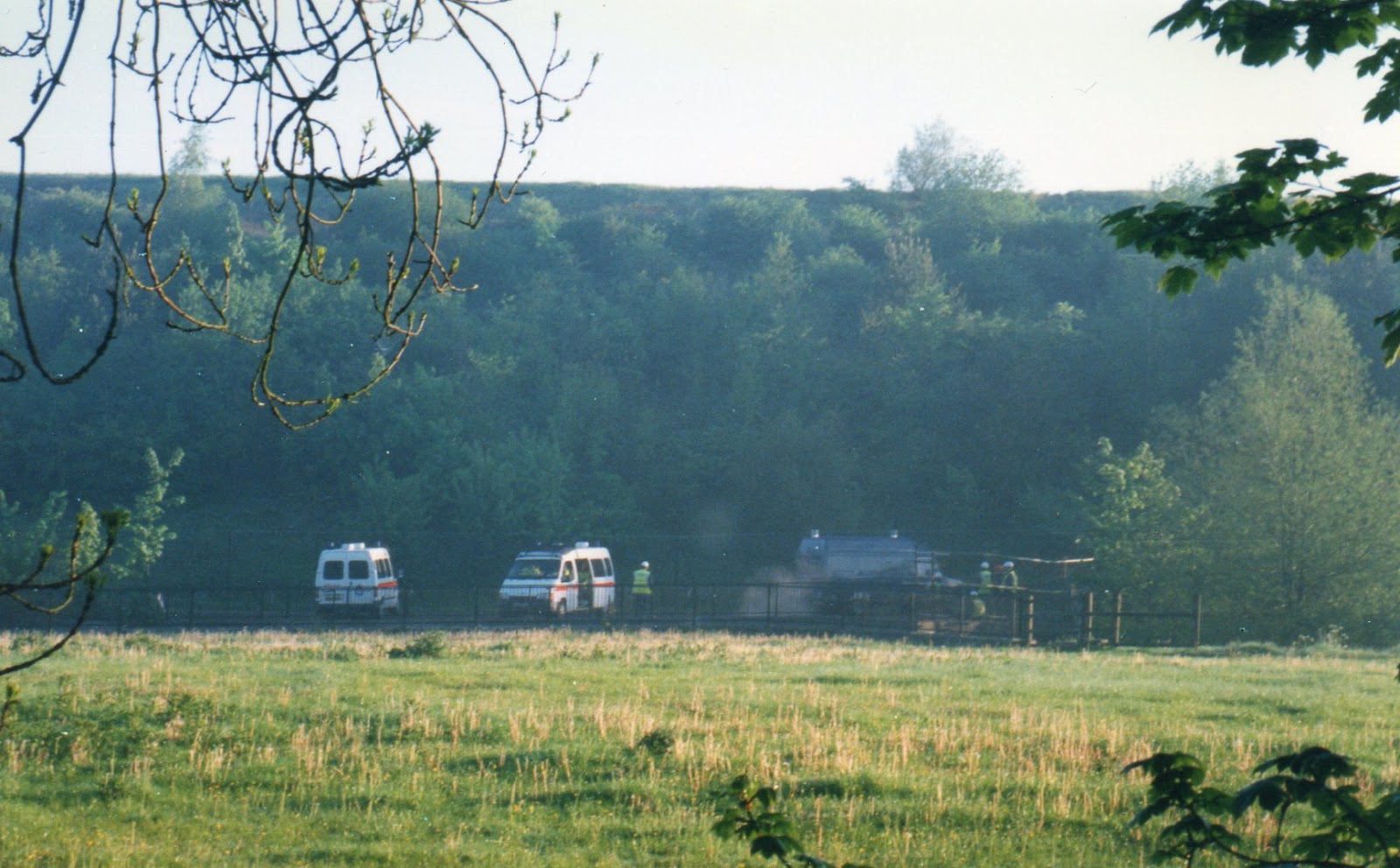
Eviction day, May 1997
If this was 1997 you would now be headed towards a security fence, lit at night by arc lights, and patrolled by Police, Bailiffs and up to 500 security guards. All this was to remove less than a hundred protesters from the sight of Manchester Airports second runway. The camps were first surrounded by wire and guards, and then the protesters were slowly removed from their treetop houses and tunnels.

Bored security, 1997
I was evicted on the first day, but I returned three days later, at night, along the path you have just walked with Ollie Big Dog and Kim. Our aim was to get back to our camp, appropriately enough called Wild Garlic, which was being evicted. We slipped between the security guards, climbed the fence at a spot where the barbed wire was missing, and evaded the bailiffs who were patrolling on quad bikes with night vision devices. I created a diversion whilst Ollie and Kim made a run for it. They didn't make it.

A few days later I returned with a BBC documentary maker. She too wanted to get inside the security perimeter. She'd asked for a cameraman, and had hoped for some young hotshot with a camcorder. instead she got a grizzled old veteran with a camera the size of a suitcase, who regaled us with stories of wars he's covered around the globe whilst we blundered around in the dark. The film never got made.

5. CAR2

Zion Tree
As you walk towards the sound of jet engines you will see the incongruous sight of fully laden jumbo jets rising slowly over the Cheshire Countryside. During the days of the campaign Against Runway 2 the aircraft appeared to grave the top of the great beech of Zion Tree camp.

The camps were located either side of the large tunnel you can now see in front of you, which was build to accommodate the River Bollin.

In 1997 protesters, and journalists looking for a scoop, soon discovered the limitations of security guards paid less than what is now the minimum wage. On dry land they'd hand you over to the police, but faced by a river a few inches deep they decided to keep their feet dry and you could walk into the site unmolested along the river.

When you join the path that runs round the perimeter of the runway, next to a wooden bridge, you will find a sign board that tells you that archaeologists discovered during the building of the runway that our medieval camps were built on the sight of a iron age farmstead. It would be too much to imagine that Lindow Man came from here, but it's not impossible.
Manchester Airport Tunnel, 1997

To visit the site of the camps themselves, take a little diversion into the tunnel.

On the right, as you enter, would have been River Rats, which you reached form here via a dodgy rope walk over the river. Beyond that would have been the Camp Cliff Richard (funny how we never got the press to run that line, especially once it had been penetrated by the Sheriffs men) where Swampy and the serious protesters lived. Beyond that and nearer the road was Flywood, home of the leery, beery trolls who snaffled the prized donations of food and booze.

Manchester Airport Tunnel, 2013
Towards the end of the tunnel and also on the right would have been Zion Tree, and on the left my own camp called, appropriately enough, Wild Garlic. No occupied trees survive, but if you carry on out of the tunnel and into the bushes on the far side you come to a steep bank on the left with a muddy ditch in front of it. technically this was probably part of Wild Garlic camp, and the ditch became our moat, complete with drawbridge. On the day it was defeated by a copper with longer than average legs, but it looked the part.

Wild Garlic camp, 1997

Although the poor old yellow hatted security guards were paid peanuts, the expert climbers and rescuers used to get the protesters out of the tree houses and tunnels were collecting a hundred pounds an hour or so for their work. We tried to make their job as hard as possible.

One of the more colourful characters in Wild Garlic was Carl, who came from a rather interesting family in New Brighton. Carl was the proud owner of more piercing than anyone else, and he tried to use these to aid the defences of the camp.

Carl meets the press with nail
When the climbers reached his tree house they found him lying with his head against the wooden pallet that made up the floor, attempting to hammer a six inch nail though the hole where his large ear stud had been using the blunt end of a hand axe. It didn't work, the nail wouldn't go into the wood, but when he gave up the climbers told him to lie back down again as they could get an hours extra work out of this. They ordered up some special tools, and then spent the next hour chatting and smoking with Carl.

My own contribution to the defence of the camp was rather more limited. Eviction day found me on day patrol. Down by the bridge across to Zion Tree i met some men in black balaclavas across the water. "Hello," I said, assuming they were with us. "F*** Off," came the reply, as they weren't. They were either a special police unit, or more likely the SAS anti-terrorist unit, called in after bogus claims we'd booby trapped the woods. They demolished the bridge, leaving the River Bollin between me and them, which I thought was a good idea. We'd though Wild Garlic would be hit first and I'd volunteered to help local activist Jeff Gazzard with the PR, so my camping days ended rather mildly as I walked off the site voluntarily.

6. The Airport

Manchester Airport
Return to the bridge and turn left out of the tunnel, heading north. As you climb up towards the fire station you will see the whole of Manchester Airport to your left. A marvellous technological achievement, modern air travel has joined the world together like no other achievement. At any one time there is the equivalent of the population of Manchester in the air. On 99 days out of 100 every single one of those passengers will arrive safely, which isn't something you can say about many means of transport.

However it is an achievement only made possible by the chance existence of oil. The kerosene used as aviation fuel has twice the energy density of TNT, and every day Manchester Airport uses 3000 tons of the stuff. As it combines with oxygen when it is burnt, a ton of aviation fuel produces three and a half times its own weight in carbon dioxide, a greenhouse gas and the primary component on man-made Climate Change. In addition the vapour trails of high flying jets also heats the air. A quick back-of-an-envelope calculation suggests that the airports contribution to Global Warming is of the same order of magnitude as the rest of the city of Manchester.

7. Styal Country Park

Yet more wild garlic...
Continue along the Runway 2 Trail. After the Fire Station the path is badly marked and continues across the grass, not down the access road. Eventually you descend down some steps to the A538, by a roundabout and near the Holiday Inn. in 1997 this was the Moat House. It didn't usually serve protesters, but if you hung around long enough you'd usually find a journalist willing to buy you a drink for a story.

Cross the main road and continue down the unused road off the roundabout to the north. It can be used as an unofficial car park, as it was in 1997, if you want to start the walk here. Had you been here on the morning of May you'd have found a bedraggled group of survivors from Zion Tree, including a journalist with a bleeding ear, and a battery of press trucks which included everything from ITN to L!VE TV - although neither the News Bunny nor any Topless Darts players were seen.
Styal Cross

At the end of the short road a sign shows you are entering National Trust land. Go through the gate and follow the path, keeping right when it branches after about 100m. You are now following the River Bollin as it meanders through a low gorge.

On the left in Arthur's Wood, the scene of another protest in 1999 when more trees were cut down during the construction of the second runway.

Cross the river at Giant's Castle Bridge then again at Oxbow bridge. The paths multiply as you enter Styal Country Park and if your not careful you can find yourself going round in circles. I kept left after Oxbow Bridge, crossed a dry valley on Chapel Bridge, and then at a small metal bridge turn left.

This takes you along the holly hedge that borders Norcliffe Chapel and then on to Styal Cross, a Victorian erection on a medieval base that has had a number of adventurers before returning to its original site a few years ago. Go through the gate marker Quarry Bank Mill.

8. Quarry Bank Mill

Quarry Bank Mill
So how did we get from venerating nature as the home of the gods (and sacrificing the odd posh person to her) to seeing it as both the source of a free lunch and a dustbin that never needs emptying?

Part of the answer is here at the mill, for we are now at the birth of the Industrial Revolution.

Built by Samuel Greg 1784, just 13 years after Richard Arkwright showed the way at Cromford, and before the steam engine was a viable concept, this water powered mill showed the future.

The scale of the mill was, for its day, astounding. But the mill didn't just represent technological step change, but a social one as well. For the first time, the working day was set by something other than the natural cycle of the earth, as people served the machines and not the other way round.

Styal Village
Whole families worked here, including children from the workhouse who weren't paid. the Greg family also owned slaves in the West Indies, but forced labour for white children continued here for years after it was outlawed for black adults.

So why did people give up their pastoral existence to become wage slaves in a Dark Satanic Mill. You've actually just walked past the answer; the picturesque Styal Village. The mill offered regular work, regular wages and a place to live, something worth the loss of the occasional finger.

Things got better of course, and it was the much maligned Victorians who sorted the factories out. But Dark Satanic Mills still exist, just not in this country, and the products of their sweated labour arrive in this country in part via Manchester Airport.

9. Wilmslow

Explore the mill if you want to, then take the path in front of the Mill Pantry marked "Picnic Area". Continue on a path that again takes you along the River Bollin. There's a diversion to the weir and further on it diverges again, but whichever route you take you eventual end up at the B5166. Turn right and cross the river on the foot bridge next to the road bridge and continue to the car park you see in front of you.

Cross the river again at the bridge and continue straight, ignoring a path to the left. Continue on past the rugby ground on Kings Road. You are now in Wilmslow, home to stars of the Premier League and Coronation Street, and a thriving Aston Martin dealership. At the end of Kings Road is the A538, along which I used to trudge in 1997 on the way to the off license. Well, there wasn't much else to do in the evening at the camps.

At the end of Kings Road turn left to the Premier Inn, on the other side of which is Lindow Moss where we started.


The route:

Leave Lindow Common by the southwest exit, cross Racecourse Road and walk down Lindow Lane, marked as a dead end. Carry on until you reach a T junction at Racecourse farm and turn left. Carry straight on at a crossroads of footpaths and byways until you come to another T junction where you join Rotherwood Road.

Turn right on Rotherwood Road and keep walking until you see a sign for a Private Nature Reserve. Carry straight on, following the purple signs for Lauren's Ride and Bridal Path to Morley. the road becomes a path and then a road again, bearing right until it arrives in the middle of Morley Green.

Cross the road, leaving the village sign on the green to the right and the Cheshire Smokehouse on the left. Continue down the road for about 500m, ignoring the footpath on the right, but taking the one on the left a few yards further on marked Castle Mill.

This leads to a path that soon becomes rather muddy that take you towards Manchester Airport. You will see a red and white radar dish in front of you. Carry straight on, following the path which keeps left when you get to a triangular field.

The path descends towards a wooden bridge. Not far past this bridge, you come to another junction. Take the footpath to the right marked Bollin Valley Way. By the tunnel under runway, join the Runway 2 Trail and turn right over the bridge.

Continue along the Runway 2 Trail. After the Fire Station the path is badly marked and continues across the grass, not down the access road. Eventually you descend down some steps to the A538, by a roundabout and near the Holiday Inn.

Cross the main road and continue down the unused road off the roundabout to the north. At the end of the short road go through the gate marked National Trust and follow the path, keeping right when it branches after about 100m, following the river. Cross the river at Giant's Castle Bridge then again at Oxbow bridge and keep left. Cross a dry valley on Chapel Bridge, and then at a small metal bridge turn left.

Follow the holly hedge that borders Norcliffe Chapel and then on to Styal Cross. Go through the gate marker Quarry Bank Mill.

Take the path in front of the Mill Pantry marked "Picnic Area". Continue on a path that again takes you along the River Bollin. There's a diversion to the weir and further on it diverges again, but whichever route you take you eventual end up at the B5166. Turn right and cross the river on the foot bridge next to the road bridge and continue to the car park you see in front of you.
 
Cross the river again at the bridge and continue straight, ignoring a path to the left. Continue on past the rugby ground on Kings Road.

At the end of Kings Road turn left to the Premier Inn, on the other side of which is Lindow Moss where we started.


Monday, 8 April 2013

Just How Evil Was Margaret Thatcher?

So she's dead is she?

I hope so, but the Twitter hash tag, #nowthatchersdead, is rather ambiguous and suggests it might be Cher who's popped her clogs.

If the Iron lady really is now undead - I mean dead - I'm sure she went to her grave believing, as many of her supporters no doubt still believe, that at least she saw the Labour movement interred first.

But despite what she thought, Thatcher didn't defeat the Left. It defeated itself. Callaghan's government, faced with economic meltdown, applied some very mild Monetarist medicine. It worked, and all that was needed to see us through the crisis was a bit of wage restraint. But that didn't happen. Instead we had The Winter of Discontent.

But this was no General Strike. There was no solidarity amongst the workers. Everyone supported their own wage claim, but opposed everyone elses. As a result a startling 83.4% of Labour voters wanted a ban on secondary picketing. Frank Chapple of the Electricians Union wondered of the vanguard socialists who led wildcat strikes, whether they were "politically motivated, misled, sick-minded or just plain stupid."

Thatcher then won power by the slimmest of margins but with broad support for moderate reforms from the country.

However there was nothing moderate about her. Her paraphrasing Saint Francis of Assisi on the steps of Downing Street were probably the most insincere words spoken by a politician - and that's saying something.

So how bad was she?

She once said that when alone she would succumb to the occasional womanly tear. I don't believe that for one moment. The only tears she was ever seen to shed were for herself, when they kicked out of Number Ten.

She may have been the first woman politician, but once in power she pulled up the drawbridge and presided over all male cabinets. Allegedly she would read them The Sun's editorials. These being on Page 2, she would fold back the paper so that the men would be looking at whoevers tits were on Page 3. If that's feminism, I'm Joan of Arc.

There is also a conspiracy theory that says that she was removed because, as the only trained scientist to become PM, she really did realise the significance of Climate Change. The evidence for this is non-existent. Her science was chemistry, and her work for J Lyons and Co. was on how to increase
the volume of ice cream by blowing cold air into it, in the process upping the profits whilst making the stuff taste like shaving foam. Think of her whenever you have a Mr Whippy.

There's really nothing to see here, but as the title of this blog is 'The Greenman', I'll take a little break from putting the boot in to look at her Green credentials. Apart from a campaign to pick up litter, this largely consisted of a speech to the Royal Society in September 1988 in which she highlighted the danger of Climate Change. Now this was a really important speech and put the matter on the world agenda for the first time, so respect to her for delivering it, and rather more respect to Sir Crispin Tickle, UN Ambassador, for writing it.

What moved her to do this? Well, according to her own book (Margaret Thatcher: The Downing Street Years) this was because environmentalists had "used the concerns about global warming to attack Capitalism, growth and industry" and she wanted "to ensure a sense of proportion". That one page reference is all Green issues got in her 900 page book. By contract, her 2002 book Statecraft (another much thumbed tome on my library shelf - NOT) devotes an entire chapter to the "much less certain" science of Climate Change and the "costly and economically damaging" plans to do something about it.

So, not exactly Swampy then.

Mrs. T. in Cloud Cuckoo Land
However, back to the title of this post, and we have Thatcher the racist, a little discussed topic even amongst those who detest her. This is the person who said "I think people are really rather afraid that this country might be swamped by people of a different culture." Nor was this just reflected in her policies. The Australian politician Bob Carr recalls a tirade against Asian immigration in front of his Malaysian born wife that left him speechless.

True she eliminated the National Front politically, but only by adopting some of their policies. Whilst campaigning in South London she asked a Black woman "What part of Africa do you come from?" "Tooting," was the reply.

Then there was her so called economic miracle. In reality the rate of growth she manged, an average of 2.4%, despite a North Sea oil bonanza, was exactly the same as in the corporate decade of the seventies, which included two oil shocks. The only difference was that in the eighties the money stayed mostly in the south of England, and mostly in the pockets of the better off. She even had her own mini-Credit Crunch in the form of Black Monday, when the stock market fell 25% in a few days. At the time it was regarded as a bit of a one off, but we know now this is what unregulated markets do every decade of so.

In conclusion, she was as bad as democratic politics gets.

She never personally ran death squads and didn't build death camps, although the use of the SAS to kill terrorist suspects in Northern Ireland, which happened after John Stalker's investigation into the more accountable RUC (which has never been published) comes pretty close to the former and her lunatic adviser Lord Monkton's suggestion of concentration camps for people with AIDS comes pretty close to the later.

However she remained good friends, until he died whilst under house arrest and facing trial for torture and kidnapping, with General Pinochet who, as well as sharing her economic views, most definitely did run death squads, and she supplied military aid to Pol Pot, who really did build death camps, a gig that even the SAS found unpalatable.

So the answer to the question at the top of the page is 'very'. Her rule was bad, but her instincts were worse.

If we were not a parliamentary democracy, if there had not been a few One Nation Tories left in her party, had there not been opposition from the arts, the Church of England and ultimately the streets, it could have been a lot worse.

I don't often say this about people, but good riddance.

My suggestion for the words on her tombstone?

"Now wash your hands".

Thursday, 28 February 2013

The Second Battle of Hastings


When the government decided to approve the obscure little road project called the Bexhill-Hastings Link Road they probably didn't think twice about it.  It promised to knock four and a half minutes off a journey along the coast and create 500 odd local jobs, at a cost of £100 million plus. At more than £150,000 per job, that seemed a little bit high, but at least the great car economy could be kept spluttering along for a bit longer.

Bender at Three Oaks
The road, though, crossed Combe Haven, a water meadow on the fringe of Hastings, that is ‘probably the finest medium-sized valley in East Sussex outside of Areas of Outstanding Natural Beauty’ – and that’s a quote from the East Sussex Council report on the road.

This prompted the Combe Haven Defenders, the sort of motley group of protesters that John Tyme would have been proud of, to leap to its defence, and when negotiations failed they took to the trees.

Indra and fishing net
Things started to kick off just as the January snow arrived. One of the few people there to have done this sort of thing before, Indra Donfrancesco, told me of freezing wet winds and protesters huddled six to a bender like dormice and kept going by hot soup delivered by local supporters.

Soon this new generation were leaping from branch to branch like the eco-warriors of Newbury, leading the professional climbers a merry dance through the branches. As Indra says “the strength comes from the strength of the trees and the power of our convictions, it awakes something deep in us all, long since compromised to servitude”.

Three Oaks Eviction
The first camp to be cleared was Three Oaks, a four hundred year old grove defended by walkways and nets, donated by local fishermen, which hung from the trees. Indra spotted a pre-dawn raid by the climbers and it eventually took a week to remove the protesters from the trees.

Other camps were also defended by tunnels and concrete lock-ons but eventually the experts brought in to clear them – one of whom claimed to have personally evicted Swampy – removed them and the trees fell.

However that doesn't appear to be the end of things. The Defenders have since then delivered a fallen tree to an East Sussex County Council Meeting and set up another camp from which to continue to disrupt tree felling and hedge clearing operations. More actions are planned.

But even if the bad guys win the Second Battle of Hastings, like they did the first, that won't be the end of it. There are currently 44 local and major road schemes under construction or due to start in the next two years, and that's not including our own Peak District Motorway. 

So we've had the Third Battle of Newbury and the Second Battle of Hastings and maybe we'll have the First Battle of Swallows Wood too, and they'll be more until we find better ways of getting about than our own personal one ton petrol driven devices. 

It's either Peak Car or Peak Motorway and it's our choice.


Monday, 4 February 2013

New Fangled Rubbish?

When Greens aren't being GM crop trashing neo-Luddites or nay-saying NIMBYs, we're usually trying to push some new fangled gadgets on the public.

This is never easy.

Take, for example, wind turbines.

Here we have all the usual reaction from people who don't want change and vested interests prepared to fund dirty tricks.

However a more serious problem is that we're pushing a technology that appears to do less but cost more.

Actually this is a hugely disputed area and, leaving aside the rather important fact that most of the costs of coal and oil, especially Climate Change, aren't factored into the bill, much of the extra cost of wind is a 'fiddle factor' to cope with fluctuating demand. This, though, is not just a problem of wind. War can double the price of oil and various factors, including algae, can knock out nukes unexpectedly, but only poor old wind has to pay extra for this problem.

However this is not a just problem for Renewable energy. The truth is, most new technologies are initially no better than the old they replace.

Take, for example, the machine gun.

You'll read in some books that the French were complete tosseurs to loose their war with Germany in 1870 as they'd secretly invented the machine gun, and if they'd only used it properly they'd have sent the spikey headed Prussians packing.

Well, no.

The French lost the war through a variety of reasons. They were out numbered, out generaled and, thanks to having no maps of their own country and a cavalry corps afraid of ambush by Algerian tribesmen (it's a long story) frequently lost. They also had, in place of real artillery, a weapon that was pants.

The Mitrailleuse, as they called it, was treated it like a cannon and grouped it in batteries. As their own artillery was usually waiting at the rear for orders that never came they frequently had to use it as a cannon too, and the German Krupp guns made mincemeat of it.

Critics said they should have used it like a modern machine gun and issued it to the infantry. However they neglect the fact that the device weighed nearly a metric ton and came on large wooden wheels. Without a team of horses it was virtually impossible to move. As secret weapons go, it came up a bit short. It's tragic history is perhaps typified by one version which was captured from the French by the Germans, given to the Boer Republic of the Transvaal, captured again by the British and pressed into service against the Boers. It doesn't appear to have been much use to any of its owners.

That anyone could regard this unreliable device as a potential war winner is to write history backwards, and to project the killing power of the Maxim guns of World War One onto its large and unworthy frame.

Or take the internal combustion engined motor car. Up until 1900 steam powered cars held all the land speed records, and also did well in early motor races.

Or the aeroplane. This seems a bit of  no-brainer, but read the history of aviation and up until the 1930s the long distance speed records are largely held by airships, mostly the Graf Zeppelin.

Or transistor radios. The sound quality of the first ones was considerably worse than that of valve radios.

Or computer games. The first mass produced game, Pong, was simpler and less interesting than the pinball machines it replaced in pubs.

And so on. In fact, often the person we remember as inventing a device is in fact just the person who got it to work properly, such as James Watt or Werner von Braun.

Eventually machine guns, petrol engined cars, aeroplanes, transistor radios and computer games would blow the opposition away completely with their abilities - literally in the case of machine guns. But at the time they first caught on, it was factors other than outright performance that gave them the edge.

Machine guns caught on because people engaging in the mucky business of Empire building found them lighter than conventional artillery and passably effective against people who, unlike the German Army, couldn't shoot back. Petrol engines were easier to start than steam engines and didn't have heavy boilers that could explode and kill you. Zeppelins were magnificent machines, but cost as much as Battleships, whereas early aeroplanes cost no more than contemporary cars. Transistors made radios much smaller, allowing kids to sneak off to listen to music their parents wouldn't approve of. I've no idea why Pong was such a success, except that it allowed ordinary people to play with something that resembled a computer.

All of which should give advocates of Green Energy something to think about.

We are at the moment in a 'Great Game' in which all the candidates for low carbon energy; on-shore wind, off-shore wind, solar, carbon capture and storage, tidal, nuclear, biomass etc are all fighting each other as well as unconventional oil.

We don't know who will win, but the raw cost of energy may well not be the most important factor. Already nuclear has pretty much dropped out of the race due to Fukoshima, even though we don't have too many Tsumamis here.

Quite possibly what will win it for renewables is the convenience of being off grid or the security of being out of the Persian Gulf or maybe something we haven't thought of yet. Certainly people seem to like having a part share in power generation or seeing the former industrial areas of Britain getting back into engineering. 

Predicting the future of technology is a mugs game.

When I was young science fiction writers thought that by now we'd have colonies on Mars but that computers would still be the size of houses. The tendency is to over emphasise whatever is grabbing the news headlines that week and ignore the underlying trend. With hindsight we should have ignored Neil Armstrong walking on the moon and spotted that a 16 bit computer could now be bought for 'only' $8000.

So what can we conclude?

Only that judging an energy by what it can do now or how well it can replace coal and oil may be a big mistake. Green Energy is the future, or rather, it must be Green Energy if we are to have a future, but what form that energy will take will be hard to predict.


Saturday, 2 February 2013

Protest Like It's 1993

It's almost like the 1990s again.

Well a bit.

Okay, so there's no Cool Britannia and nobody's remotely pretending that we're in some sort of classless society any more.

However we have an unpopular Tory government and all the paraphernalia that goes with it: back bench revolts over Europe, cuts, unemployment, collapsing health service, homeless people, soup kitchens etc etc

And we have people camping in the trees trying to stop a road.

I don't know how many people really remember the tree folk of the nineties. In a history of the decade Swampy appears well below Kurt Cobain, Damien Hurst, and the Gallaghers, although his reputation has survived better than New Labour and Lance Armstrong's.

However the tree folk were a grass roots movement that took on and beat the government, which is actually pretty rare.

What basically happened in the 1990s was that amongst the large and growing opposition to the government - the dispossessed of Tory Britain - there emerged a radical environmental group that pretty rapidly found its cause in 'the biggest road building program since the Romans'.

That group was Earth First!

Earth First! wasn't the 1990s anti-roads movement, but it was the yeast in the dough. With it's rallying cry of "no compromise in the defence of mother earth" and it's broader definition of what could be defined as 'non-violent direct action', it made even groups like Greenpeace seem staid and conformist.

Imported from the USA by Jake Bowers and Jason Torrence, who stripped away the Redneck Individualism and spliced in some home grown Anarchism, Earth First! UK was then cross-fertilised by ideas and activists from the then winding down opposition to Greenham Common and Cruise Missiles what emerged was a new and radical environmental group.

(I should add that this ideological transformation was also happening in America thanks to the activist Judi Bari and anarchist philosopher Murray Bookchin [amongst others], but some of the yanks who came over to advise the Brits in the early years were misogynistic Mountain Men who didn't exactly hit it off with feminists former peace campaigners.)

The British Earth First!ers spent their first few years blocking nuclear power stations and shipments of rainforest timber, whilst experimenting with innovative tactics such as the ethical shoplifting of clearcut timber.

Then a couple of Travellers started camping on Twyford Down.

They were soon joined by local activists opposed to the planned M3 extension and Friends of the Earth. The latter had allegedly joined the party as they thought Labour would win the 1992 General Election and cancel the road, offering them a cheap victory. When this didn't happen they soon disappeared, threatened by legal action and for the rest of the 1990s FOE and EF! had a bit of a stormy relationship.

Into the breach though stepped Torrence, Bowers and co. With a very British spirit of making it up as you go along, they camped on the path of the proposed motorway and were violently removed on the infamous Yellow Wednesday.

It was a defeat, no doubt, and the despoiled Down went on to have starring role in the opening credits of the Vicar of Dibley, but also a beginning.

Borrowing another tactic from the US, tree squatting, first used in Newcastle by campaigners against tree cutting in Jesmond Dean, future camps were about ground and much harder to shift. In due course tunnels, off-site actions and covert 'monkey wrenching' were added to the activists toolkit.

Success breeds success, and many people who had previously been rioting in the streets or leading the march towards Global Socialism temporarily changed flags and became non-violent, non-hierarchical eco-warriors.

After the Third Battle of Newbury saw over a thousand arrests, the Treasury pulled the plug on the Department of Transport's plan.

With no more trees to squat Earth First! found itself at a bit of a loose end. A proposed new runway at Manchester airport gave them a years grace, but then the crisis came. The type of actions they wanted to do next required the ability to organise activists secretly, which was just not possible with the diverse individuals that made up the movement. Build a treehouse and they will come. Organise a  secret action on a 'need to know' basis and they won't.

Earth First! threw itself into the campaign against GMOs, taking out small test sites in the middle of the night, but they were fringe players in the campaign which was led by Greenpeace, Friends of the Earth and, unfortunately, the Daily Mail.


With EF! no longer setting the pace, other causes drew people's time; the annual anti-capitalist riot in London, the perpetual camps at Faslane and Huntingdon Life Sciences and so on. Normal services had been resumed.

In a sense Earth First! had played Malcolm X to the other NGO's Martin Luther King. Malcom X, although a  massive hero to many Black Americans, actually spent his time lurching from one ideology to to another, picked up some dubious friends in the Nation of Islam and was eventually bumped off by fellow black radicals.

Earth First!, similarly, acquired some diverse ideologies in its travels, from Rednecks for Wilderness to eco-pagans. It picked up some dodgy fellow travellers from the animal rights movement and eventually shrank to almost nothing as its best and brightest were poached by the big NGOs, who offered salaries, offices and the resources to launch a campaign even if there weren't any convenient trees.

This wasn't so much selling out as just moving up, as many Earth First! groups, especially the good ones, were mini-NGOs; just under funded and under staffed ones which were perpetually having to reinvent the wheel.

But now in Sussex people were back in the trees protesting the Tory's new roads to nowhere. it's not another Newbury - yet - but they were well organised, not scared of the press and had the big NGOs on board. All of which is a big improvement on how we did things.

What happens next will be interesting.

There is a lot of anger out there, a lot of former Occupy people, UK Uncut people, and a heck of a lot of disillusioned ex-Labour people. Somewhere out there is the cause that will unite them all. It could be roads, it really could, but it could be any number of things.

But equally, it might not be fun at all.

I had it easy as a nineties protesters. They treated us with kids gloves. Now the eighties, that was a violent decade.

All told I'd rather protest like 1993.

Sunday, 20 January 2013

Saving the Peak District.....in Sussex

Looking back on my career as an eco-warrior, it isn't exactly full of heroic victories.

Newbury got it's bypass, Manchester Airport built its Second Runway and even Farmer Brigham managed to save most of his crop of GM maize.

There were a few wins along the way. Lyminge Forest never received a Rank Holiday Village, Brewery Fields eventually became a wildlife haven and the Great Bear Rainforest was saved.

However as main memory of Lyminge is skinny dipping on Hythe beach, my only contribution to Brewery Fields was to camp there in the rain for a couple of days, and my part in saving Canada's forests involved clowning around in London whilst activists were blocking logging roads in the middle of nowhere (and getting 30 days in prison as a result), I'm not sure how much credit I can claim for these.

But I think that misses the point. Ten thousand trees may have bit the dust building the Winchester-Preston Trunk Road, but by defending a fair number of them Salisbury's water meadows were saved. The Bollin Valley may now be spanned by Manchester Airport's second runway, but the village of  Sipson has yet to make way for Heathrow's third.  And whilst GM crops may have continued to grow in Norfolk after Lord Melchett's adventure, they don't grow there now.

Noisy defeats, silent victories was the soundbite I repeated as often as I could.

(I may have been a media tart, but at least I was a media tart with a message.)

The thing is, when you lie down in front of bulldozers, the bulldozers usually win, but (and this is a very big but) that does not make it pointless.

Sometimes you win the moral victory - although I'm struggling to think of an example.

Sometimes you simply push up the cost of the project until nobody can afford it - which is what happened to the last Tory road building project.

Sometimes you make the issue too politically toxic for any sensible politician to touch - as with GM and Heathrow.

But more often you simply nudge the cost/benefit equation a little more in your direction until eventually they give up.

Her in Glossop we are in a phony war situation with our proposed new road, the one formerly known as the Mottram-Tintwistle Bypass, but which has been revealed as a trans-Pennine motorway.

Officially the project is dead, having not been funded in the last five year budget of the Northwest Regional Development board and with its long running and frequently shambolic Public Enquiry abandoned.

In reality we all suspect that it's just lying dormant, ready to reappear when the new money arrives in 2015 and it can be a test case for the new, streamlined planning laws.

But that's not to say that nothing can be done to stop the road, and indeed stuff is being done, just not by me.

Down in Hastings they're down in tunnels and up in trees trying to stop the Bexhill-Hastings Link Road. It's a second Battle of Hastings, and seeing as how the bad guys won in 1066, lets hope the goodies win in 2013.

That's not very likely, but that's not the point.

They are fighting the battle to stop the Longendale Motorway right now, in the snow, and hats off to them.

It was pretty cold in the woods in Newbury 27 years ago too, but we were just camping then, with some recreational tree-cutting disruption on the side. By the time the evictions started the sun wasn't exactly cracking the flags, but it was warmer than it is now. An eviction in the snow doesn't sound like any sort of fun.

So if you can, help them out. I've bunged 'em a bit of cash and if there's anyone out there I know who wants to get down there, I'll buy you your train ticket.

But if you can't make it, don't worry. There's plenty more roads and shit planned, like the A555 in Stockport and the new 'World Logistics Hub' at Manchester Airport, which are all in the queue ahead of the Longendale motorway.

In the long run we'll win. Fossil fuels are a thing of the past and the future is greener and cleaner. At some point we'll get Peak Car, and probably before we get the Peak Motorway. These roads and runways are just the last gap of the old, the new is already on the way.

Someone, somewhere is going to be the last person evicted from the path of one of these dinosaur projects. It's highly unlikely to be me, or Sitting Bull down in Sussex, but it could be you.

And if it is you can rightly claim to have been part of a great moment in the history of Civilisation.

The moment the human race realised that to win a war on nature is to be on the loosing side.

Tuesday, 8 January 2013

Monterey Pop Festival

Woodstock, the high water mark of flower power. The biggest ever free festival. Three days of peace and love and music. The mythical Ur-festival that all others try, and fail, to live up to.

Well maybe.

There are a lot of myths about the sixties, and most of them seem to be about Woodstock. So what's the truth?

Well, first off the festival wasn't dreamed up by flower children living in an ashram. Instead, the original genius came from two Trustafarians playing golf. Wondering what to do with their parents money, one suggested a organising a music festival. The other agreed. After all, he said, "how much trouble can you get into putting on a concert?"

The answer was a lot. It started with sixties radical Abbie Hoffman extorting $10,000 to buy off his Yippie army, and ended with a state of emergency being declared and the National Guard flying in supplies in military helicopters. How not to organise a festival.

In between there was some good music though. There were those like Country Joe McDonald, Canned Heat, Janice Joplin, Jefferson Airplane and Jimi Hendrix, who had been the big names of the sixties and whose fame - and in two cases lives - were coming to an end. Then there were those like Santana, Sly and the Family Stone, Ten Years After and Crosby, Stills, Nash and Young who were just starting out and who would be big in the seventies.

But the music wasn't that good. Pete Townsend said it was the worst gig The Who ever played, although he was a little distracted by Abbie Hoffman leaping onto the stage during "Tommy" and grabbing Roger Daltrey's mike to rant about a mate who'd been nicked. The Who weren't really the band to try this trick with and Townsend applied his guitar to the Yippie's head, and his boot to his behind, and sent him on his way.

Next year, of course, it got even worse. At Altamont the Rolling Stones encamped in a fortified back stage area to enjoy their champagne whilst their Hells Angels minders ran riot, in the process knocking out Jefferson Airplane's lead singer and killing - in disputed circumstances - an armed black man.

So much for peace and love then.

However the myth of Woodstock lives on, in large part thanks to Joni Mitchell's song, which imagines it as an earthly paradise. 'Imagines' though is the word as she wasn't there in person, having a pressing PR appointment instead.

But there was a sixties festival where it all went right, a festival which really is the model which all modern festivals follow, or at least the good ones.

The Monterey Pop Festival took place in June 1967 Monterey, California. This was the summer of love, and Scott McKenzie had just told everyone what to wear in San Francisco.

Monterey by Grace Slick
The plan was for a festival with the the best of everything. Where artists would find great facilities and where the audience would hear great bands, and it was all to be done for charity.

The Mamas and Papas were the driving force behind the gig. The venue had been running a regular jazz festival for nearly a year. Jazz was considered 'real music' and the aim was to give rock the same status and respect. This was important. Rock bands at the time struggled to play decent venues, with old cinemas and theatres down on their luck being where most gigs got played. The Who's classic album, Live at Leeds, was recorded in the Refectory at the Students Union, which was pretty impressive for the time.

Monterey aimed to change things, firstly by providing the artists with the best facilities possible. At Woodstock, by contrast, even providing back stage toilets was a bit of an afterthought. The back stage area was also not the fortress guarded by thugs that it was at Altamont. Famous faces were seen mingling with the crowds throughout the weekend and Jimmy Hendrix apparently spent one night jamming in a nearby building.

It's Hendrix who generally gets remembered. Making love to and then igniting his guitar. He'd lost a coin toss to The Who, who played before him and were the first to trash their instruments.

Also playing that weekend was Otis Redding, in his first big gig to a mainly white audience, Janice Joplin, playing her most important gig to date, The Byrds, Jefferson Airplane, who also played a breakthrough performance, Canned Heat, Simon and Garfunkle, The Animals, Country Joe and the Fish,  The Mamas and Papas and Ravi Shankar. The last played a four hour set on the Sunday morning, which must have tested the patience of all but the extremely stoned.

Care was also taken to ensure that those who attended also had fun and stayed safe. As well as a well supplied First Aid station, volunteers were on hand to help people through bad trips. At Woodstock services were overwhelmed and they had to call the Army in, whilst backstage at Altamont resembled a bizarre war movie where First Aiders tending the numerous victims of Hells Angel violence were beset by alternative therapists trying to mend broken bones with crystals and good vibes.

Festival security worked well with the Monterey police who in turn found the hippies far less frightening than they'd expected. The hippy scene in California would eventually become grimmer and nastier, as pimps and drug dealers preyed on the naive waifs and strays who headed west. But in '67 everyone really did wear flowers in their hair, even the police.

Maybe it was because these early pioneers were more Middle Class than the runaways who came to populate the Haight-Ashbury District later, and where Charles Manson would eventually take up residence. But California was also the heart of hippydom. In New York the Yippies and others had fantasies of revolutionary violence and treated new arrivals as cannon fodder for the cause. Meanwhile in San Francisco the Diggers actually put a bit of effort into making an alternative community, taking in the bewildered and feeding the hungry.

Similarly, unlike the rampantly commercial Woodstock, which only became a "free" festival after $3 million of tickets, and more importantly the movie rights, had been sold, the only organisation to make money out of Monterey was the Monterey Pop Foundation Foundation, a charity that still exists today.

However despite all this Monterey remains relatively forgotten. It's not even been possible to buy the film in Europe for a while. (Fortunately you can watch it on Youtube.)

Why this is is a bit of a mystery. But maybe it's because there really is no other narrative. Woodstock was always Heaven to some and Hell to other. Altamont provides every reason imaginable to go 'told you so' to the Flower Children, but at Monterey there really was no downside.

But that was then. What about now? Where can you go to find a festival where it really is safe, where the artists are treated with respect but where the musicians emerge to meet the punters, where everything is both relaxed and well organised, where the music is varied but always good and where you can possibly even meet the odd - and now rather elderly - Flower Child?

Well, if you read this blog regularly you'll know my answer to this one: Cropredy.

(If you don't belive me about Monterey, try this page by someone who actually was there.)